.png)



The 30-Second Answer
What is EDI dropshipping for apparel brands?
EDI dropshipping is the automated workflow that lets a retailer like Nordstrom, Macy's, or Walmart send a single customer order to an apparel brand electronically over EDI, and have the brand ship the product directly to the customer — without ever taking the inventory into the retailer's warehouse. The flow runs on six core EDI transactions: 850 (order), 855 (acknowledgment), 856 (advance ship notice with tracking), 810 (invoice), 820 (payment), and 997 (acknowledgment of receipt).
- ✓EDI 850 arrives the moment a customer checks out — one order, one ship-to
- ✓EDI 856 ASN is the chargeback-prone document; it powers the customer's tracking page
- ✓DSCO, Rithum, Mirakl sit alongside EDI — they don't replace it
- ✓Walmart, Macy's, Wayfair, Nordstrom each run dropship slightly differently
- ✓Apparel dropship is harder than other verticals because of style × color × size matrices
On This Page
Jump to Section
- 01What Is EDI Dropshipping?
- 02Dropship vs Bulk Wholesale
- 03The Core EDI Transactions
- 04Step-by-Step Dropship Process
- 05EDI Shipping & the 856 ASN
- 06EDI Shipping Process
- 07EDI Shipping Instructions
- 08DSCO, Rithum, Mirakl Explained
- 09Retailers Running Dropship Programs
- 10EDI Drop Ship Program Setup
- 11The Apparel Inventory Matrix
- 12EDI Chargebacks & Prevention
- 13Managed EDI Dropship Services
- 14EDI Pricing Models at Scale
- 15The ERP + EDI + WMS + 3PL Stack
- 16EDI vs API: Do You Need Both?
- 17Glossary
- 18Frequently Asked Questions
What Is EDI Dropshipping?
EDI dropshipping is a retail fulfillment model where a retailer sends a customer order to a brand electronically using Electronic Data Interchange (EDI), and the brand ships the product directly to the end customer. The retailer owns the storefront and the customer relationship; the brand owns the inventory and the fulfillment. EDI dropship and drop ship EDI both refer to the same process — the automated, document-driven workflow that connects retailers to apparel suppliers without manual paperwork.
In EDI dropshipping, the retailer never physically handles the product. A customer buys an apparel item on the retailer's website, the retailer transmits an EDI 850 purchase order to the brand, the brand's apparel ERP creates a sales order, the warehouse picks and ships directly to the customer, and the brand confirms the shipment with an EDI 856 advance ship notice (ASN) and invoices with an EDI 810. EDI shipping happens entirely through the 856. Every step is automated.
For an apparel brand looking to scale into Nordstrom, Macy's, Kohl's, Walmart, Amazon, Farfetch, or any marketplace program, EDI dropshipping is the operational model that makes it possible. The difference between scaling cleanly and drowning in chargebacks comes down to one thing: whether your EDI, ERP, warehouse, and 3PL operate as one connected stack, or four disconnected tools.
This guide explains exactly how the dropship flow works, what each EDI document does, how DSCO, Rithum, and Mirakl fit in, how Walmart, Macy's, Nordstrom, and Wayfair run their dropship programs differently, and what it takes to ship compliantly to major retailers without bleeding margin to chargebacks.
How EDI Dropshipping Differs from EDI Bulk Wholesale
EDI dropshipping is direct-to-consumer fulfillment with one order per EDI 850; EDI bulk wholesale is store-replenishment fulfillment with one large order containing hundreds of units. Most growing apparel brands run both models in parallel because each serves a different retailer relationship.
In EDI bulk wholesale, the retailer issues a large purchase order, you ship cartons of inventory to their distribution center, and the retailer fulfills downstream customer orders from their own stock. Fewer transactions, larger shipments, retailer carries the inventory risk after receipt. This is the traditional wholesale model that has powered department-store apparel for fifty years, and it still drives the largest revenue lines for most apparel brands.
In EDI dropshipping, the retailer issues hundreds or thousands of single-customer orders, each routed individually to your warehouse for direct-to-consumer fulfillment. Higher transaction volume, smaller shipments, you carry the inventory risk until the unit sells. Dropship has grown rapidly because it lets retailers expand assortment without committing inventory dollars upfront — a strategic shift that has accelerated since 2020.
| Feature | EDI Dropship | EDI Bulk Wholesale |
|---|---|---|
| Order type | Individual customer orders | Large retailer purchase orders |
| Who ships | Brand ships to end customer | Brand ships to retailer DC |
| Inventory owner | Brand (until unit sells) | Retailer (after receipt) |
| Order volume | High frequency, small orders | Lower frequency, large orders |
| Compliance pressure | Tight (per-order ASN timing) | Moderate (per-shipment) |
| EDI cadence | Steady stream of 850/856/810 | Batched, fewer transactions |
| Best fit | Ecommerce expansion, long-tail SKUs, marketplaces | Seasonal buys, store replenishment |
Brands that operate both models inside one apparel ERP get a critical advantage: shared inventory visibility, so a unit allocated to a Macy's dropship customer is not also promised against a Nordstrom bulk PO. Without that single source of truth, oversells follow within weeks of adding the second channel. The same apparel ERP software that handles your bulk wholesale orders should also handle dropship — otherwise inventory desyncs become a daily problem and reconciliation eats your operations team's time.
EDI Transactions Used in Dropshipping: The Six Core Documents
EDI dropshipping uses six core EDI transactions, all defined by the ANSI X12 standard maintained by the Accredited Standards Committee X12. Each EDI transaction has a specific role in the dropship order-to-cash flow. Miss the timing on any of them and chargebacks follow. The full set runs 850, 855, 856, 810, 820, and 997 — the same documents bulk wholesale uses, but with different volume profiles, timing windows, and operational pressure.
Two additional EDI transactions show up in dropship-adjacent flows: the EDI 940 (Warehouse Shipping Order) used when retailers send shipping instructions directly to your 3PL, and the EDI 846 (Inventory Inquiry/Advice) used to push real-time inventory snapshots to dropship retailers so they can update their storefront availability. Most apparel dropship programs revolve around the core six, but Walmart, Wayfair, and several mass retailers expect 846 inventory feeds at minimum.
EDI 850 — Purchase Order in Dropship Context
In dropshipping, an EDI 850 is a single customer order — not a bulk replenishment. The retailer's system transmits an 850 the moment a customer completes checkout. It contains one ship-to address (the customer's home), one or a few line items (style, color, size, quantity), a requested ship date, and retailer-specific routing instructions (carrier preference, label format, gift-wrap flag, branded packing slip rules).
This per-order 850 cadence is what makes dropship volume-intensive. A brand running 30 retailer dropship programs at moderate volume can receive 3,000–10,000 EDI 850s per month. Every one must be parsed, validated, and converted into a sales order within minutes — manual processing is impossible at this scale. Bulk wholesale 850s arrive in batches with hundreds of line items per PO; dropship 850s arrive as a constant stream with one line item each.
EDI 855 — PO Acknowledgment
In dropshipping, the 855 is where you accept, reject, or partial-fill the customer order. Some retailers require an 855 within minutes of the 850; others don't require one at all. The dropship-specific risk is the acceptance window: if the customer-facing tracking page reads "awaiting confirmation" too long, the retailer may auto-cancel the order and issue a cancellation chargeback. The 855 closes that loop and triggers the visible "order confirmed" status on the retailer's customer-facing page.
EDI 856 — Advance Ship Notice (ASN): The Dropship Document
The EDI 856 ASN is the most chargeback-prone document in apparel dropshipping. In dropship context, the 856 carries the tracking number that powers the retailer's customer tracking page. When a Nordstrom dropship customer clicks "track my order," they are seeing data the brand transmitted in an 856. Late ASN, wrong tracking number, or mismatched ship-to almost always triggers a chargeback because it breaks the customer experience.
Apparel dropship ASN is more complex than commodity ASN because it can carry pack hierarchy data — shipment > orders > packs > items. For polybagged single-unit dropship orders this is simpler. For multi-line dropship orders the hierarchy must reflect what's physically in the package. Most apparel retailers require an Advance Ship Notice with pack hierarchy even when the dropship carton contains a single SKU.
EDI 810 — Invoice in Dropship Context
In dropshipping, an EDI 810 invoices one customer order at a time, not a bulk shipment. This high invoice volume creates two operational realities: one, your invoicing system must run continuously, not nightly; two, every 810 must match the corresponding 850 and 856 exactly. Retailers perform three-way match (850 vs. 856 vs. 810) before releasing payment. Mismatches stall cash flow and trigger short-pay deductions on the next EDI 820.
EDI 820 — Payment / Remittance Advice
The 820 communicates payment details, deductions, and chargebacks. Dropship 820s often carry many small deductions — $5 here for a late ASN, $25 there for a wrong SCAC code. Brands that ignore the 820 miss the data they need to dispute chargebacks and reconcile cash. The 820 is where every operational mistake from the previous 30 days surfaces as a line item on your remittance.
EDI 997 — Functional Acknowledgment
The 997 confirms an EDI document was received by the other system. It confirms transmission only, not correctness. In high-volume dropship operations, 997 monitoring is critical: a missing 997 on an outbound 856 means the retailer never got the ASN, which means a chargeback is coming. Brands without 997 monitoring discover failed transmissions days later, after the chargeback has already been issued and the customer has already complained.
EDI 940 — Warehouse Shipping Order (3PL Dropship)
The EDI 940 Warehouse Shipping Order appears when a retailer routes shipping instructions directly to a brand's 3PL. The 940 contains the same shipping data as the 850 from the retailer's perspective, but it's addressed to the warehouse instead of the brand. In dropship operations using a 3PL, the 940 is what triggers the actual pick-pack-ship event. Wayfair, Walmart, and some Amazon vendor flows use the 940 alongside the 850 to give the 3PL direct shipping authorization.
For a deeper look at every EDI transaction type AIMS360 supports across apparel operations, see our complete apparel EDI software guide.
EDI Dropshipping Process: Step-by-Step Apparel Workflow
The EDI dropshipping process for apparel runs in eleven steps from customer checkout to retailer payment. Inside a connected apparel ERP and EDI stack, every step happens automatically — no spreadsheets, no portal logins, no manual data entry. The same workflow applies to drop ship EDI orders from any retailer; the only thing that changes between Nordstrom and Macy's and Walmart is the specific routing rules at step 6 and the ASN window at step 9.
Visual Reference
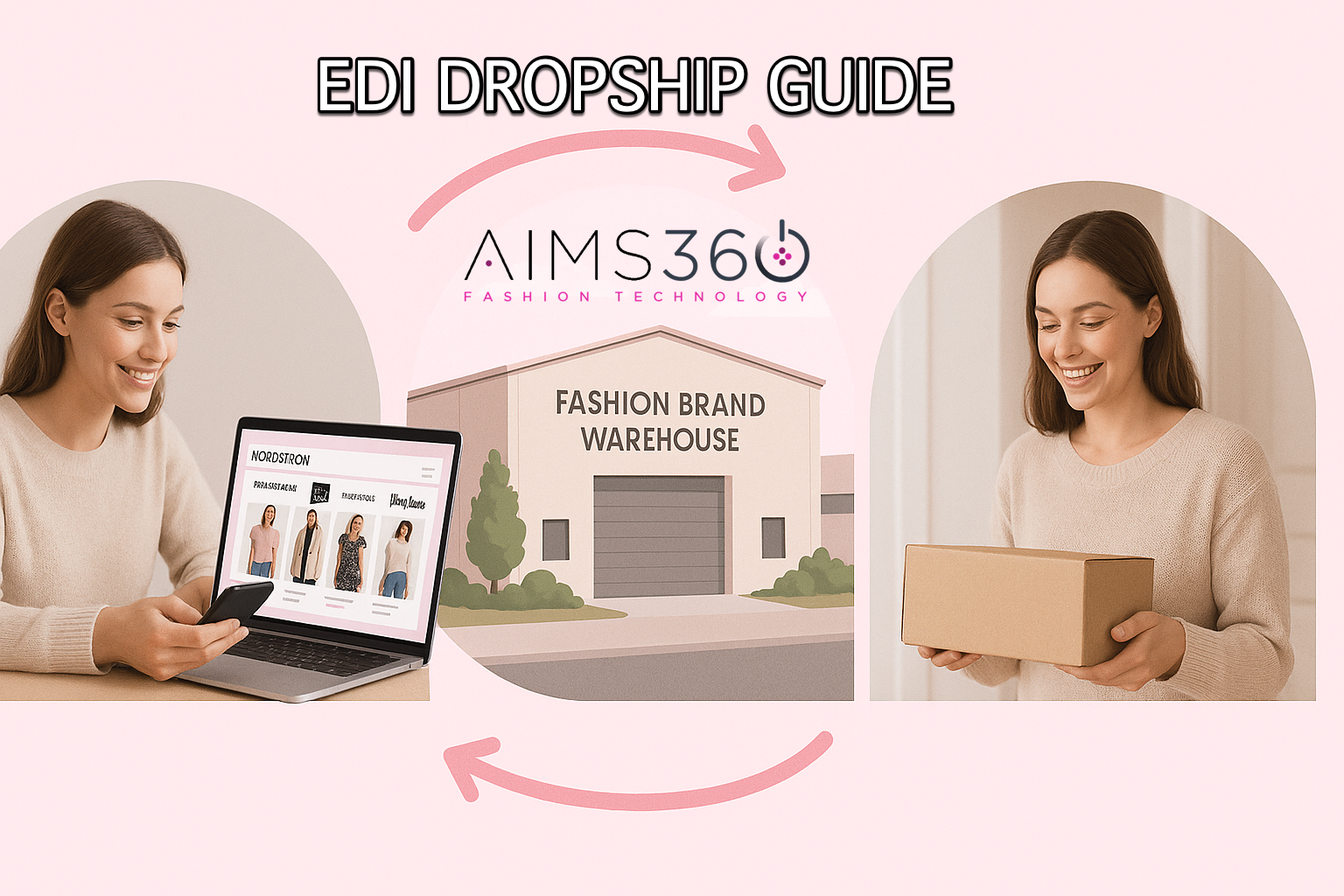
The EDI Dropshipping Flow: From Retailer Order to Brand Payment
- Customer buys a dress on Nordstrom's website
- Nordstrom's system transmits an EDI 850 to your EDI inbox
- Your EDI software validates the file and posts a 997 acknowledgment back
- The 850 drops into your apparel ERP and creates a sales order — style, color, size validated against your inventory matrix
- The ERP allocates the unit from the correct warehouse or 3PL based on ship-to ZIP, inventory availability, and routing rules
- The Warehouse Management System (WMS) prints a pick ticket and a Nordstrom-compliant shipping label (carrier, service level, UCC-128 if required)
- The unit is picked, packed, and tendered to the carrier
- The carrier scans the label and returns a tracking number to the WMS
- Your EDI software generates an EDI 856 ASN with the tracking number and transmits it inside Nordstrom's ASN window (usually within hours of ship confirmation)
- Your ERP generates an EDI 810 invoice for the shipped unit and queues it for transmission
- Nordstrom processes payment and eventually returns an EDI 820 remittance
That is the difference between a brand that can scale to 50 retailer dropship programs and a brand that drowns at five. The brands that scale do not have better people — they have better systems, with every step above happening as a system event rather than a human task.
EDI Shipping in Apparel Dropship: The ASN Is the Whole Game
EDI shipping in apparel dropshipping comes down to one document: the EDI 856 advance ship notice. Brands searching for "edi shipping" or "edi in shipping" or "shipping edi" are almost always trying to solve the same problem — how to send a clean, on-time 856 that the retailer accepts on the first attempt. The phrase changes; the underlying question is identical.
Apparel ASN is harder than commodity EDI shipping because retailers want pack hierarchy data — they need to know not just that you shipped 12 units, but how the units are grouped: shipment > orders > packs > items. For polybagged single-unit dropship orders this is simpler. For mixed multi-line dropship orders, the hierarchy must reflect the physical package.
Common reasons apparel dropship ASNs fail retailer validation:
- Tracking number transmitted before the carrier scans the label (carrier rejects the tracking ID at validation)
- Wrong SCAC code (Wayfair, Walmart, Macy's each publish their own approved carrier code list)
- Mismatched ship-to address (the ASN address must exactly match the 850 ship-to, not your warehouse's normalized version)
- Late ASN — most retailers require the 856 within 1 hour of carrier pickup; some allow 24 hours; almost none tolerate next-day
- UCC-128 label barcode does not match the ASN pack ID
- Ship-from address on the 856 does not match the brand profile in the retailer's vendor portal
Apparel-focused ERPs that generate the 856 directly from the warehouse scan event — instead of from a batch overnight job — avoid most of these failures. The label and the ASN come from the same data event, so by definition they match. This is the structural reason brands using event-driven ASN have lower chargeback rates than brands using batch ASN, regardless of headcount or experience.
EDI Shipping Process: From Pick Scan to Retailer Confirmation
The EDI shipping process in dropship is the sequence between the warehouse pick scan and the retailer's confirmation that your 856 was accepted. It's where most chargebacks are generated and where most operational problems surface.
The clean EDI shipping process for an apparel dropship order looks like this:
- WMS picks the unit and scans the bin location
- Pack station scans the unit into a carton
- Carrier-compliant label prints (UCC-128 if the retailer requires it; ship-to and ship-from match the 850 exactly)
- Carton is tendered to the carrier
- Carrier scans the label and returns a tracking number through the carrier API
- EDI 856 ASN is built from the same data event that printed the label
- ASN transmits to the retailer through the configured channel (AS2, SFTP, or VAN)
- EDI 997 confirms retailer receipt within minutes
- Retailer's vendor portal updates the order status to "shipped"
- Customer sees "shipped" + tracking on the retailer's order page
When any step breaks, the customer sees stale tracking, the retailer issues a chargeback, and your seller score drops. The brands running clean EDI shipping operations have all ten steps connected through a single system event rather than ten separate integrations.
EDI Shipping Instructions: What Retailers Actually Send You
EDI shipping instructions are the rules in a retailer's routing guide that govern how you ship and how you transmit the EDI 856 ASN. Every retailer you onboard sends you one. Apparel routing guides typically run 80 to 200 pages.
A typical apparel routing guide specifies:
- Which carriers and service levels you may use
- The exact SCAC code to populate in the 856 (defined by the National Motor Freight Traffic Association, the body that issues SCAC codes)
- Label format (Zebra ZPL, PDF, dimensions)
- UCC-128 placement on the carton (now formally called GS1-128, defined by GS1 US)
- Box weight tolerances
- Acceptable ship windows from the order date
- ASN transmission window and acceptable transmission method (AS2, SFTP, VAN)
- Chargeback schedule for each violation
Reading, mapping, and operationalizing a routing guide for every retailer is where internal EDI teams struggle most. It's the single biggest reason brands choose managed EDI services — a managed service provider has already mapped the major retailer routing guides, and you inherit that work. A brand connecting to its tenth retailer should not have to read its tenth routing guide cover to cover; the right managed service has already done it.
DSCO, Rithum, and Mirakl: What They Actually Do
DSCO, Rithum, and Mirakl are not EDI replacements — they are platforms that sit alongside EDI in the modern retail dropship stack. Here is the clear version of how each one works and where EDI still fits underneath.
DSCO
Dropship workflow
Supplier connectivity and dropship workflow platform. Retailers use DSCO to onboard suppliers, sync catalogs, route orders, and update inventory. DSCO is now part of Rithum.
Replaces EDI? No. Many DSCO programs still run EDI 850/856/810 underneath. DSCO handles orchestration; EDI handles the transactions.
Rithum
Commerce network
Parent platform combining DSCO, CommerceHub, and ChannelAdvisor. The multi-channel commerce backbone retailers use to manage supplier networks at scale.
Replaces EDI? No. It's the network you reach the retailer through, not the transaction layer. Your apparel ERP and EDI software still do their jobs.
Mirakl
Marketplace infrastructure
Marketplace software powering retailer-operated marketplaces. Macy's, Kroger, Best Buy, and dozens of European retailers run Mirakl marketplaces.
Replaces EDI? Typically API-based instead of EDI, but operationally identical (real-time inventory, fast fulfillment, accurate tracking).
Retailers and Marketplaces Running Apparel EDI Dropship Programs
The apparel EDI dropship landscape spans traditional department stores, mass retailers, ecommerce-first players, marketplaces, and specialty channels. AIMS360 connects apparel brands to drop ship EDI programs at:
- Department stores: Macy's, Bloomingdale's, Nordstrom, Saks Fifth Avenue, Saks Off 5th, Neiman Marcus, Bergdorf Goodman, Dillard's
- Mass and big-box: Walmart, Target, Kohl's, Costco
- Lifestyle and specialty: Anthropologie, Urban Outfitters, Free People, Boot Barn
- Ecommerce and marketplaces: Amazon Vendor Central, Amazon Marketplace, Zappos, Farfetch, Fanatics
- Home and lifestyle with apparel categories: Wayfair, Williams Sonoma, Pottery Barn, West Elm
Each retailer runs its dropship program slightly differently. Onboarding to a new retailer means reading a new routing guide, building a new EDI map, and certifying a new connection. For the complete list of EDI-connected retailers AIMS360 supports for both dropship and bulk programs, see the AIMS360 EDI retailer integrations page.
Walmart EDI Dropship
Walmart EDI dropship runs through Walmart Marketplace and Walmart DSV (Drop Ship Vendor) programs, both with strict routing guides and aggressive chargeback enforcement. Walmart requires EDI 850, 855, 856, 810, and 997 at minimum, with EDI 940 used in some 3PL flows. Walmart's SCAC code list is published in its routing guide and updated frequently. Walmart EDI ASN must transmit inside a tight window, and Walmart's three-strike chargeback policy makes ASN compliance non-negotiable. Walmart EDI shipping carrier codes are unique to Walmart and don't map cleanly from other retailers — every brand onboarding to Walmart dropship has to map them fresh.
Wayfair EDI Dropship
Wayfair runs one of the most active dropship programs in apparel-adjacent categories (loungewear, sleepwear, home apparel). Wayfair requires EDI 850, 855, 856, 810, and 846 inventory feeds at minimum, all with strict format requirements. Wayfair's vendor portal pairs with EDI to give brands real-time visibility into compliance and chargebacks. For brands operating dropship through Wayfair specifically, see the Wayfair EDI compliance and integration guide.
Macy's, Nordstrom, and Department-Store Dropship
Macy's Vendor Direct Fulfillment and Nordstrom's dropship program are the two most established department-store apparel dropship channels. Both require EDI 850, 855, 856, and 810. Both enforce tight ASN windows and detailed routing guides. Macy's tends to be more forgiving on label format; Nordstrom is stricter on shipping carrier selection. Saks Fifth Avenue, Bloomingdale's, and Dillard's run similar programs with retailer-specific variations.
EDI Drop Ship Program Setup: The Onboarding Sequence
An EDI drop ship program with a major retailer follows a predictable onboarding sequence, and brands that scale across many retailers learn to run this sequence in parallel rather than serially. The standard sequence is:
- Apply through the retailer's vendor portal
- Receive routing guide, EDI specs, and test environment credentials
- Build or import the EDI map for the retailer's 850/855/856/810/997 specifications
- Exchange test files through the retailer's testing platform
- Complete the retailer's certification checklist (data accuracy, timing, error handling)
- Receive go-live approval
- Begin receiving production EDI 850 orders
Standard timeline for a single retailer onboarding is two weeks to three months depending on retailer complexity and supplier readiness. Brands using managed EDI dropship services compress this significantly because the maps for major retailers already exist and only need configuration, not building from scratch.
The Apparel-Specific Problem: Style, Color, Size, and the Inventory Matrix
Apparel EDI dropshipping is harder than dropshipping in any other vertical because of the inventory matrix. A single apparel product is not a single SKU — it's a grid.
A women's slim-fit denim jacket might exist as:
- 4 washes
- 7 sizes
- 2 length variants
That is one style, 56 SKUs. A 200-style line carries 11,200 dropship-eligible SKUs. Each retailer expects real-time inventory updates on every SKU. A unit committed to a Nordstrom dropship customer cannot also be promised to a Macy's customer or held against a wholesale PO. The inventory math compounds at every retailer added.
This is where generic dropship platforms and generic ERPs fall apart. They were built around a flat SKU list, not a 4-dimensional matrix (style × color × size × warehouse). When the inventory update lags, oversells happen. When oversells happen, retailers issue cancellation chargebacks and lower your seller score, which throttles future order volume. Lower seller score means fewer orders, which means lower revenue, which means less budget to fix the operational problem causing the oversells.
A purpose-built fashion ERP software handles the matrix natively — color and size grids are first-class concepts, not custom fields bolted onto a generic product table. The inventory engine understands that a size 6 in indigo is a different SKU from a size 6 in black, and that committing the indigo to dropship doesn't reduce the black available for wholesale.
EDI Chargebacks: What Triggers Them and How Apparel Brands Prevent Them
EDI chargebacks are financial penalties retailers issue when a supplier violates routing guide rules. In apparel dropship, the most common chargeback triggers are:
- Late ASN (EDI 856 transmitted outside the retailer's window)
- ASN/shipment mismatch (units shipped do not match units declared on the 856)
- Wrong UCC-128 label format or placement
- Wrong carrier or service level versus routing guide
- Late ship (carrier pickup outside the order-to-ship window)
- Cancellation due to inventory unavailable (oversell)
- Invoice errors (810 does not match 850 + 856)
- Wrong SCAC code on the ASN
- Missing or invalid tracking number
Per-event chargeback amounts range from $5 to $250+ per violation depending on the retailer and severity. A brand running 5,000 dropship orders per month with a 3% chargeback rate at an average $25 penalty is losing $3,750 per month — before the indirect cost of lowered seller scores and reduced order allocation. Compound that across 20 retailers and chargebacks become the second-largest cost line in the dropship P&L behind cost of goods.
Prevention is structural, not tactical. Brands running clean dropship operations have:
- ASN generated directly from the carrier scan event, not from a batch job
- Real-time inventory sync across all dropship retailers and all warehouses
- Routing-guide-driven carrier and label selection at the WMS level
- Continuous EDI 997 monitoring so failed transmissions surface in minutes
- Pre-validation of every outbound EDI file against retailer maps
- Automated chargeback dispute workflow when the brand has evidence the violation didn't occur
This is built into AIMS360 apparel software by design, not bolted on. The point isn't to fight chargebacks after they're issued — the point is to never trigger them in the first place.
Built for Apparel Dropship
Scale dropship without scaling chargebacks
AIMS360 handles EDI 850 receipt to 810 transmission inside one apparel ERP. No middleware, no per-document fees.
Managed EDI Dropship Services: When to Use Them
Managed EDI dropship services make sense when a brand has more than two or three active retailer programs and lacks a full-time internal EDI analyst. Building and maintaining EDI maps for every retailer routing guide is a full-time job. Most apparel brands under $50M in revenue do not staff that internally.
A managed EDI dropship service typically handles:
- Reading and interpreting each retailer's routing guide
- Building and maintaining EDI maps per retailer
- Running connection testing and certification with the retailer
- Monitoring transmission success and chargeback reports
- Updating maps when retailers publish routing guide revisions (1–4 times per year per retailer)
- Onboarding new retailers as you add dropship programs
- Pre-flighting outbound EDI files to catch errors before transmission
The alternative is hiring an in-house EDI analyst at $90K–$150K plus benefits, plus the cost of an EDI translator platform, plus the maintenance overhead of every retailer's routing-guide updates. For brands under roughly 50 active retailer connections, managed services are almost always cheaper and faster.
AIMS360 includes managed EDI dropship services as part of the platform — no separate EDI middleware, no per-document fees, no per-line fees, no per-transaction fees, no kilocharacter fees. The same managed team that handles your initial retailer onboarding handles ongoing maintenance and new retailer additions. When Macy's publishes a routing guide update at midnight, your maps get updated before your team reads the email.
EDI Fees
$12.5K–$25K
Monthly EDI fees at 10,000 dropship orders on transaction-based pricing
Routing Guides
80–200
Pages in a typical apparel retailer routing guide, updated 1–4× per year
Chargeback Range
$5–$250+
Per-event apparel chargeback, with late ASN and oversells at the top of the range
Why Apparel EDI Pricing Models Matter at Scale
EDI pricing matters for apparel dropship because most third-party EDI providers charge by usage: per document, per line item, per kilocharacter, or per transaction. This pricing model punishes growth, which is exactly the opposite of what an apparel brand needs from a strategic infrastructure vendor.
Run the math on a 10,000-order dropship month:
- 10,000 EDI 850s received
- 10,000 EDI 855s sent (if retailer requires)
- 10,000 EDI 856 ASNs sent
- 10,000 EDI 810 invoices sent
- 10,000 EDI 997s sent
- Average 5 line items per document = 250,000 line items billable
At $0.25–$0.50 per document, that month costs $12,500–$25,000 in EDI fees alone. Scale to 30,000 orders and you are paying $37,500–$75,000 monthly just to move EDI files. By the time a brand is doing $50M in dropship revenue, EDI fees can equal an entire mid-level salary.
Flat-rate ERP-integrated EDI removes this cost variable entirely. Your cost-per-order does not climb with volume. This is the structural reason brands eventually migrate off transaction-priced EDI platforms — the math stops working the moment you cross meaningful scale.
The Stack: ERP + EDI + WMS + 3PL Working as One System
EDI dropshipping does not run on EDI alone. The full operational stack is four connected layers:
- Apparel ERP — handles styles, colors, sizes, sales orders, inventory across warehouses, financials. This is the system of record.
- EDI software — receives and sends 850/855/856/810/820/997 transactions and translates between retailer formats and your ERP
- Warehouse Management System (WMS) — controls picking, packing, labeling, and shipping inside the warehouse
- 3PL integration — extends the WMS into outsourced fulfillment locations
When these four components live in four separate systems, the integrations between them become your operational ceiling. A retailer 850 has to enter the EDI system, exit to the ERP, exit to the WMS, exit to the 3PL, return shipment data to the WMS, return to the ERP, return to the EDI system, and exit as an ASN. Each hop is a failure point, and the more retailers you add, the more failure points multiply.
When the stack is unified — ERP, EDI, WMS, and 3PL connectors inside one platform — the 850 flows through internal events instead of integrations. AIMS360 is built this way specifically for apparel: one platform that handles all four layers natively for fashion brands.
EDI vs API: Which Do Apparel Brands Need?
Apparel brands selling across channels need both EDI and API integration. Different channels require different integration types:
- EDI is required by virtually every traditional retailer dropship program (Macy's, Nordstrom, Kohl's, Walmart, Target)
- API is used by ecommerce platforms (Shopify, BigCommerce), marketplaces (Amazon Seller Central, Farfetch, Mirakl-powered marketplaces), and some newer dropship platforms (DSCO has both EDI and API options)
The right apparel ERP handles both — EDI inbound from major retailers, API inbound from marketplaces and direct-to-consumer — and treats both as the same kind of order downstream. The brand's warehouse, accounting, and inventory shouldn't know or care whether an order arrived via EDI 850 or a Shopify webhook; both should produce the same sales order in the ERP and trigger the same fulfillment workflow.
Quick Reference: EDI Dropshipping Glossary for Apparel Brands
- EDI — Electronic Data Interchange, the standardized format for retailer/supplier document exchange
- EDI transaction — A specific document type exchanged over EDI, identified by a three-digit number (850, 856, etc.)
- 850 — Purchase Order
- 855 — PO Acknowledgment
- 856 / ASN — Advance Ship Notice
- 810 — Invoice
- 820 — Payment / Remittance Advice
- 940 — Warehouse Shipping Order (used in 3PL dropship flows)
- 846 — Inventory Inquiry/Advice (real-time inventory feed to retailers)
- 997 — Functional Acknowledgment
- UCC-128 — Standardized shipping label / carton ID barcode required by most major retailers (now called GS1-128 under GS1 standards)
- SCAC — Standard Carrier Alpha Code; the 2-4 letter carrier identifier the ASN must use, issued by the NMFTA
- VICS BOL — Voluntary Inter-industry Commerce Standards Bill of Lading; used in apparel freight shipments
- VAN — Value Added Network; a private network for transmitting EDI between trading partners
- AS2 — Direct internet-based EDI transmission protocol (alternative to VAN)
- Routing guide — Retailer-published document containing all shipping, labeling, and EDI compliance rules
- Chargeback — Financial penalty issued by a retailer for routing-guide non-compliance
- DSCO — Dropship workflow platform now part of Rithum
- Rithum — Connected commerce platform combining DSCO, CommerceHub, and ChannelAdvisor
- Mirakl — Marketplace infrastructure platform powering retailer-operated marketplaces
Scale Your Apparel Dropship Program with AIMS360
AIMS360 combines apparel ERP, built-in EDI software, warehouse management, 3PL connectors, and managed EDI dropship services into one platform — built specifically for fashion brands. No middleware. No per-document fees. No per-transaction fees. Predictable pricing that does not punish growth.
For brands selling through DSCO, Rithum, Mirakl-powered marketplaces, or directly through major retailer dropship programs like Macy's, Nordstrom, Walmart, Wayfair, and Amazon, AIMS360 handles the entire flow — from EDI 850 receipt to EDI 810 invoice transmission, with the EDI 856 ASN compliance that keeps chargebacks down at scale.
Ready to See It in Action?
Book a free AIMS360 demo
See how AIMS360 handles retailer dropship onboarding, ASN compliance, and full order-to-cash on one connected apparel software platform.
Frequently Asked Questions: EDI Dropshipping for Apparel
What is EDI dropshipping?+
EDI dropshipping is a fulfillment model where a retailer transmits a customer order to a brand electronically using Electronic Data Interchange, and the brand ships the product directly to the end customer. The retailer owns the customer relationship; the brand owns the inventory and handles fulfillment.
What does EDI stand for in business?+
EDI stands for Electronic Data Interchange. In business, EDI is the standardized computer-to-computer exchange of structured documents — purchase orders, invoices, shipment notices, payment data — between trading partners. EDI replaces email, fax, and manual portal data entry, allowing transactions to flow automatically between systems. In apparel, EDI is how brands communicate with retailers like Nordstrom, Macy's, and Walmart for both dropship and bulk wholesale.
What does EDI stand for in shipping?+
EDI stands for Electronic Data Interchange. In shipping, EDI is the standardized format that retailers and brands use to exchange purchase orders, shipment confirmations, tracking information, and invoices between their systems instead of using email or manual portals.
What are EDI transactions?+
EDI transactions are the individual document types exchanged over Electronic Data Interchange, each identified by a three-digit number defined by the ANSI X12 standard. The core EDI transactions used in apparel dropshipping are the 850 (Purchase Order), 855 (PO Acknowledgment), 856 (Advance Ship Notice), 810 (Invoice), 820 (Payment/Remittance), and 997 (Functional Acknowledgment). Additional transactions like the 940 (Warehouse Shipping Order) and 846 (Inventory Advice) appear in specific dropship and 3PL flows.
What is EDI shipping?+
EDI shipping is the use of Electronic Data Interchange to communicate shipment data between a supplier and a retailer. The core EDI shipping document is the EDI 856 Advance Ship Notice, which tells the retailer what shipped, when, by which carrier, and with what tracking number. For apparel brands, EDI shipping also covers UCC-128 carton labels and SCAC carrier codes specified in retailer routing guides.
What is EDI in drop shipping?+
In drop shipping, EDI is the automated transaction layer that lets a retailer send a single customer order directly to a supplier, and lets the supplier confirm shipment and invoice without manual data entry. The main EDI documents used in drop shipping are the 850 purchase order, 856 advance ship notice, 810 invoice, and 997 acknowledgment.
What is an EDI drop ship program?+
An EDI drop ship program is a retailer-operated channel where suppliers receive single-customer orders over EDI and ship directly to the end customer. Major apparel EDI drop ship programs include Macy's Vendor Direct Fulfillment, Nordstrom Drop Ship, Walmart DSV (Drop Ship Vendor), Kohl's Online Drop Ship, and Wayfair Dropship. Each program has its own routing guide, EDI specifications, and onboarding sequence.
What is EDI shipping instructions?+
EDI shipping instructions are the rules a retailer publishes in its routing guide that govern how suppliers must ship and how the EDI 856 ASN must be formatted. They specify allowed carriers, SCAC codes, label format (often UCC-128), ASN transmission window, packaging rules, and chargeback amounts for each violation. Apparel routing guides typically run 80 to 200 pages per retailer.
What is the EDI shipping process for apparel dropship?+
The EDI shipping process for apparel dropship is the sequence between the warehouse pick scan and the retailer's confirmation that your 856 was accepted. It runs from WMS pick scan, through pack-station scan, label print, carrier handoff, tracking number return, EDI 856 ASN build, ASN transmission, EDI 997 confirmation, retailer order-status update, and finally customer-visible tracking. When the process is event-driven from the warehouse scan, mismatches between label and ASN cannot occur.
What is EDI 850 in dropshipping?+
In dropshipping, an EDI 850 is a single-customer purchase order — not a bulk replenishment. The retailer's system transmits an 850 the moment a customer completes checkout, containing the customer's ship-to address, style, color, size, quantity, requested ship date, and retailer-specific routing instructions. A brand running multiple retailer dropship programs receives thousands of 850s per month, each requiring automated parsing and sales-order creation.
What is EDI 855 in dropshipping?+
In dropshipping, the EDI 855 is the order acceptance signal. The brand sends an 855 back to the retailer to accept, reject, or partial-fill the customer order. Some retailers require an 855 within minutes of the 850 so the customer-facing tracking page can update from "awaiting confirmation" to "confirmed." Others do not require it. Acceptance-window enforcement is stricter in dropship than in bulk because the customer is watching.
What is EDI 856 ASN in dropshipping?+
In dropshipping, the EDI 856 ASN carries the tracking number that powers the retailer's customer tracking page. When a dropship customer clicks "track my order," they are seeing data the brand transmitted in an 856. This makes the 856 the most chargeback-prone document in dropship — late ASN, wrong tracking number, or mismatched ship-to breaks the customer experience and triggers a penalty.
What is EDI 810 in dropshipping?+
In dropshipping, an EDI 810 invoices one customer order at a time, not a bulk shipment. This creates two operational realities: invoicing must run continuously, not nightly, and every 810 must match the corresponding 850 and 856 exactly. Retailers perform three-way match (850 vs. 856 vs. 810) before releasing payment, so mismatches stall dropship cash flow.
What is EDI 820 in dropshipping?+
In dropshipping, the EDI 820 is where many small chargebacks surface — $5 for a late ASN, $25 for a wrong SCAC code, $50 for a label mismatch. Because dropship transaction volume is high, the deduction total in any given 820 can be significant. Brands that ignore the 820 cannot dispute chargebacks or reconcile cash accurately.
What is EDI 997 in dropshipping?+
In dropshipping, the EDI 997 confirms a document was received by the other system. It confirms transmission only, not correctness. In high-volume dropship operations, a missing 997 on an outbound 856 means the retailer never got the ASN — which means a chargeback is on its way. Continuous 997 monitoring is required at dropship volume.
What is EDI 940 in dropshipping?+
EDI 940 is the Warehouse Shipping Order. In dropshipping, the 940 appears when a retailer routes shipping instructions directly to a brand's 3PL instead of the brand. The 940 contains the same shipping data as the 850 from the retailer's perspective, but it's addressed to the warehouse. Wayfair, Walmart, and some Amazon vendor flows use the 940 alongside the 850 to give the 3PL direct shipping authorization.
How does Walmart EDI dropship work?+
Walmart EDI dropship runs through Walmart Marketplace and Walmart DSV (Drop Ship Vendor) programs. Walmart requires EDI 850, 855, 856, 810, and 997 at minimum, with EDI 940 used in some 3PL flows. Walmart's SCAC code list and routing guide are published in the Walmart vendor portal and updated frequently. Walmart's three-strike chargeback policy makes ASN compliance non-negotiable, and Walmart EDI shipping carrier codes don't map cleanly from other retailers — every brand onboarding to Walmart dropship has to map them fresh.
What is the difference between EDI dropshipping and EDI bulk wholesale?+
EDI dropshipping involves a high volume of single-customer orders shipped directly from the brand to the end customer, with the brand carrying inventory risk until each unit sells. EDI bulk wholesale involves lower-frequency, large purchase orders shipped to the retailer's distribution center, with the retailer taking inventory ownership at receipt. Most growing apparel brands run both models in parallel inside one apparel ERP.
How does EDI ASN work in apparel dropshipping?+
In apparel dropshipping, the EDI 856 ASN is generated when the warehouse scans the shipping label and the carrier returns a tracking number. The ASN includes ship-to address, units shipped, carrier SCAC code, tracking number, and pack hierarchy. It must be transmitted inside the retailer's published ASN window, usually within hours of carrier pickup. A clean ASN matches the original 850 ship-to and product detail exactly.
What are EDI shipping codes?+
EDI shipping codes are the standardized codes used inside the EDI 856 ASN and related documents to identify carriers, service levels, and packaging types. The most important is the SCAC (Standard Carrier Alpha Code), a 2-4 letter code that identifies the carrier — UPSN for UPS, FDEG for FedEx Ground, USPS for the Postal Service, and so on. Each retailer publishes its approved SCAC list in its routing guide.
What is an EDI advance ship notice?+
An EDI advance ship notice is the EDI 856 document. It is sent by the brand to the retailer at the moment of shipment and contains all the shipping data the retailer needs to track and receive the order. In apparel dropshipping, the advance ship notice also drives the customer tracking experience on the retailer's website.
Does DSCO replace EDI?+
No. DSCO is a supplier connectivity and dropship workflow platform, not an EDI replacement. Many DSCO-connected programs still exchange EDI 850, 856, and 810 transactions underneath. DSCO handles orchestration — catalog sync, inventory updates, supplier onboarding — while EDI handles the structured transaction layer. Apparel brands connecting through DSCO typically need both.
What is Rithum?+
Rithum is a connected commerce platform that combines DSCO, CommerceHub, and ChannelAdvisor. It is the network retailers and brands use for multi-channel commerce, supplier networks, and dropship orchestration. Rithum is not an ERP and not an EDI translator. Apparel brands selling through Rithum-connected retailers still need their own apparel ERP and EDI software underneath.
What is Mirakl?+
Mirakl is marketplace infrastructure software. When a retailer turns its website into a marketplace and onboards third-party sellers, Mirakl is often the platform underneath. Mirakl integrations are typically API-based rather than EDI-based, but the operational requirements — real-time inventory, fast fulfillment, accurate tracking — are the same as EDI dropshipping.
Which retailers run EDI dropship programs for apparel?+
Major apparel EDI dropship programs include Macy's, Bloomingdale's, Nordstrom, Saks Fifth Avenue, Neiman Marcus, Dillard's, Kohl's, Walmart, Target, Amazon Vendor Central, Zappos, Farfetch, Anthropologie, Urban Outfitters, Free People, Boot Barn, Wayfair, Williams Sonoma, and Fanatics. The specific dropship model varies by retailer; many also offer EDI bulk wholesale programs alongside dropship.
What are EDI chargebacks in dropshipping?+
EDI chargebacks are financial penalties retailers issue when a supplier violates routing guide rules. The most common dropship triggers are late ASN, ASN mismatch, wrong UCC-128 label format, wrong carrier or service level, late ship, oversells leading to cancellation, and invoice errors. Per-event chargebacks range from $5 to $250 or more depending on the retailer and severity.
How can apparel brands prevent EDI dropship chargebacks?+
Prevention is structural. Brands with clean dropship operations generate the ASN directly from the carrier scan event rather than a batch job, maintain real-time inventory sync across all retailers and warehouses, drive carrier and label selection from the routing guide at the WMS layer, monitor EDI 997 acknowledgments continuously, and pre-validate every outbound EDI file against retailer maps before transmission.
What is EDI mapping for dropship retailers?+
EDI mapping is the process of translating data between your apparel ERP's internal format and each retailer's required EDI format. Every dropship retailer has slightly different field requirements, code lists, and segment structures. Correct mapping ensures that ship-to addresses, product identifiers, quantities, and carrier codes all populate exactly the way the retailer expects — which is what keeps chargebacks down at scale.
What is EDI onboarding with a retailer?+
EDI onboarding is the process of setting up a new retailer connection. It typically includes reviewing the retailer's routing guide, building the EDI maps, exchanging test files, completing the retailer's certification checklist, and going live. Timelines vary widely — anywhere from two weeks to several months depending on retailer complexity and supplier readiness.
What are managed EDI dropship services?+
Managed EDI dropship services are an outsourced model where an EDI provider handles routing guide interpretation, map building, retailer certification, transmission monitoring, and ongoing map maintenance. For apparel brands under roughly 50 active retailer connections, managed services are usually cheaper and faster than hiring an in-house EDI analyst and licensing a standalone EDI translator.
Why does EDI pricing matter for growing apparel brands?+
Most third-party EDI providers charge by usage — per document, per line item, per transaction, or per kilocharacter. This pricing model punishes growth: a brand running 10,000 monthly dropship orders can pay $12,500 to $25,000 per month in EDI fees alone, scaling linearly with order volume. Flat-rate ERP-integrated EDI removes this cost variable, so cost-per-order does not climb with scale.
Do apparel brands need EDI, API, or both?+
Both. EDI is required by virtually every traditional retailer dropship program — Macy's, Nordstrom, Kohl's, Walmart, Target. API is used by ecommerce platforms like Shopify, marketplaces like Amazon Seller Central and Farfetch, and many Mirakl-powered retailer marketplaces. Apparel brands selling across channels need an ERP that handles both natively.
What is the difference between EDI and API integration?+
EDI is a standardized batch-style document exchange protocol used primarily by traditional retailers, with structured transaction sets like the 850, 856, and 810. API integration is a real-time request/response model used by ecommerce platforms and modern marketplaces. EDI tends to be slower and more formal; API tends to be faster and more flexible. Both can run side by side in the same apparel ERP.
Why is apparel EDI dropshipping harder than dropshipping in other verticals?+
Because of the inventory matrix. A single apparel style typically exists in multiple colors and sizes, producing dozens of SKUs per style. A 200-style line can carry over 10,000 dropship-eligible SKUs that all need real-time inventory sync across multiple retailers and warehouses. Generic dropship platforms built around flat SKU lists struggle with the style-color-size matrix and lead to oversells, cancellations, and chargebacks.
What is UCC-128 and why does it matter for dropship ASN?+
UCC-128 is the standardized shipping label and carton ID barcode required by most major retailers for dropship cartons and inbound shipments. The UCC-128 barcode on the carton must match the pack ID inside the EDI 856 ASN exactly. Mismatches between the label barcode and the ASN are one of the top chargeback triggers in apparel dropshipping.
What is a routing guide?+
A routing guide is the document a retailer publishes that contains every shipping, labeling, packaging, and EDI compliance rule a supplier must follow. Apparel routing guides typically run 80 to 200 pages and specify allowed carriers, SCAC codes, label format, ASN timing windows, ship-from validation rules, and chargeback amounts for each violation. Routing guides are updated one to four times per year per retailer.
What systems work together to run EDI dropshipping for apparel?+
EDI dropshipping requires four connected layers: an apparel ERP as the system of record for styles, colors, sizes, orders, and inventory; EDI software to translate and transmit retailer documents; a warehouse management system to control picking, packing, labeling, and shipping; and 3PL integration to extend fulfillment into outsourced warehouses. When these four layers live in one platform, the operational ceiling is much higher than when they are stitched together from separate vendors.


