Explore AIMS360's apparel business software
FREE DEMO
Fashion & apparel ERP

ERP software for fashion & apparel brands scaling wholesale, DTC and retail

AIMS360 is the vertical apparel ERP, the apparel management software and fashion business software stack in one platform, built for apparel brands and manufacturers: contemporary, denim, activewear, swim, intimates, bridal, suiting, sleepwear, luxury, streetwear, children's and uniforms. Built for the operational reality of selling into Nordstrom, Macy's, Bloomingdale's, Target, Walmart and Saks while running Shopify and Amazon DTC, with PLM, pre-packs, factor financing and 3PL integration handled out of the box.

AIMS360
For apparel brandsFor manufacturers
45+
Years in apparel ERP
350+
Retailer EDI partners
97.5%
Implementation success
Categories covered

Every fashion & apparel product type, on one platform.

AIMS360 manages the full catalog complexity of apparel: size-color-style matrices, pre-packs and assortments, tech packs and BOMs, season-based costing and the retailer EDI every brand needs.

Women's apparel

  • Tops & blouses
  • Dresses & jumpsuits
  • Pants & trousers
  • Denim & jeans
  • Skirts & shorts
  • Sweaters & knitwear
  • Outerwear & coats
  • Suiting & tailored
  • Contemporary & luxury

Men's apparel

  • Shirts & tees
  • Pants & chinos
  • Denim & jeans
  • Suits & tailored
  • Sweaters & knitwear
  • Outerwear & jackets
  • Shorts & swim
  • Streetwear & casual
  • Contemporary & luxury

Children's & kids'

  • Infant & baby clothing
  • Toddler 2T-4T
  • Kids 4-14
  • Tween & junior
  • School uniforms
  • Children's outerwear
  • Sleepwear & pajamas
  • Kids' activewear & swim
  • Boutique & specialty

Activewear & athleisure

  • Yoga & pilates
  • Running & performance
  • Athleisure & lounge
  • Sports bras
  • Leggings & bottoms
  • Technical & compression
  • Training tops & tanks
  • Outdoor & cross-training
  • Team & uniform

Swim & resort

  • Women's swimsuits & bikinis
  • Men's swim trunks
  • Kids' swim
  • Cover-ups & sarongs
  • Resortwear
  • Cruise & vacation
  • Beach accessories
  • UPF & sun protection
  • Modest swim

Intimates & sleep

  • Bras & underwear
  • Shapewear
  • Lingerie & sleepwear
  • Robes & loungewear
  • Hosiery & socks
  • Bridal lingerie
  • Maternity intimates
  • Plus & extended sizing
  • Performance intimates

Specialty & formal

  • Bridal & bridesmaids
  • Evening & gowns
  • Cocktail & party
  • Special occasion
  • Tuxedo & formal menswear
  • Maternity
  • Plus-size
  • Adaptive apparel
  • Made-to-measure

Manufacturing & uniforms

  • Domestic apparel mfrs
  • Contract manufacturers
  • Private label producers
  • Uniforms & workwear
  • Medical scrubs
  • Hospitality uniforms
  • Promotional & corporate
  • Team & spirit wear
  • Sustainable & recycled
The operational reality

Apparel breaks generic ERP. Every time.

Every horizontal ERP, NetSuite, Acumatica, SAP Business One, Microsoft Dynamics, was built around the idea that a product is a SKU. In apparel, a product is not a SKU. A product is a style. A style has multiple colorways. Each colorway has a size run. Each combination is a SKU. A single style at 4 colors × 8 sizes is already 32 SKUs. Add a pre-pack assortment, and the math gets worse from there.

Every apparel brand running a generic ERP has built the same set of workarounds. Custom fields. Manual spreadsheets bridging PLM to ERP to PIM to retailer portal. Workarounds for pre-packs. Workarounds for factor financing. Workarounds for retailer chargebacks. Workarounds for season-based costing. The workarounds become infrastructure, and the infrastructure becomes technical debt that ages with the brand.

AIMS360 was built as apparel software, apparel-first more than 45+ years ago, the original clothing ERP for this market, and rebuilt continuously since. Everything the workarounds were trying to do, AIMS360 just does. Size-color-style matrices are first-class entities. Pre-packs are first-class. Tech packs and BOMs flow directly into production. Retailer EDI for 350+ retailers ships in the box. Factor integration is included. Seasonal costing, in-season pricing changes, season-end markdown, all native.

The four operational truths that define apparel:

1. The matrix is the unit of work. Inventory, ordering, picking, ASNs, allocation, costing, every operation in apparel happens at the style-color-size level. A brand that can't pivot fluently across those three dimensions can't run apparel.

2. Wholesale and DTC pull from the same pool. A Nordstrom PO and a Black Friday Shopify weekend draw from the same warehouse. Without explicit allocation rules, one channel always steals from the other. Most apparel brands lose 1-3% of revenue per year to overselling or under-shipping caused by this.

3. The retailer specifies how you operate. Routing guides, EDI specs, carton labels, ASN windows, vendor scorecards, chargeback structures, every major retailer dictates how their suppliers run logistics. Brands that try to manage 5 retailers manually quickly find that compliance becomes their full-time job.

4. Seasons drive everything. Apparel is not a steady-state business. It's a sequence of season launches, in-season replenishment, markdown cycles and exit strategies. The costing changes through the season. The pricing changes. The channel mix changes. The system has to handle it natively or the team handles it manually.

What AIMS360 delivers

Three capability blocks built for the apparel operator

The platform handles every operational reality above. Here is what that looks like inside the system.

PLM, production & sourcing

Tech packs, BOM, supplier collaboration, sample tracking, cost engineering and approval workflows. Domestic and overseas production in one system, with full WIP visibility.

  • Tech packs with construction details, trims and graded specs
  • BOM with vendor sourcing and yield calculation
  • Cut tickets, work orders and contractor POs
  • Landed cost: FOB, freight, duty, broker, factor

Wholesale, EDI & factor

Managed EDI to 350+ retailers, ASN generation to spec, UCC-128 labels, factor integration and chargeback dispute workflow, all native, not bolted on.

  • Nordstrom, Macy's, Bloomingdale's, Saks, Target, Walmart and more
  • Factor integration with CIT, Rosenthal, Hilldun, Wells Fargo
  • Chargeback tracking, dispute and evidence workflow
  • Pre-pack and assortment management throughout

DTC, marketplace & B2B

Omnichannel OMS unifies Shopify, Shopify Plus, Amazon, Faire, Joor, NuOrder and B2B portals against a single inventory pool with channel allocation rules.

  • Native Shopify and Shopify Plus integration
  • Amazon Seller Central and Vendor Central plus FBA
  • Joor, NuOrder and B2B wholesale portals
  • Channel allocation rules to prevent oversells
How AIMS360 handles apparel

From design through finance close, the workflows that matter.

Apparel operations have a predictable shape, and AIMS360 maps that shape directly into the platform with specific configurations for each step.
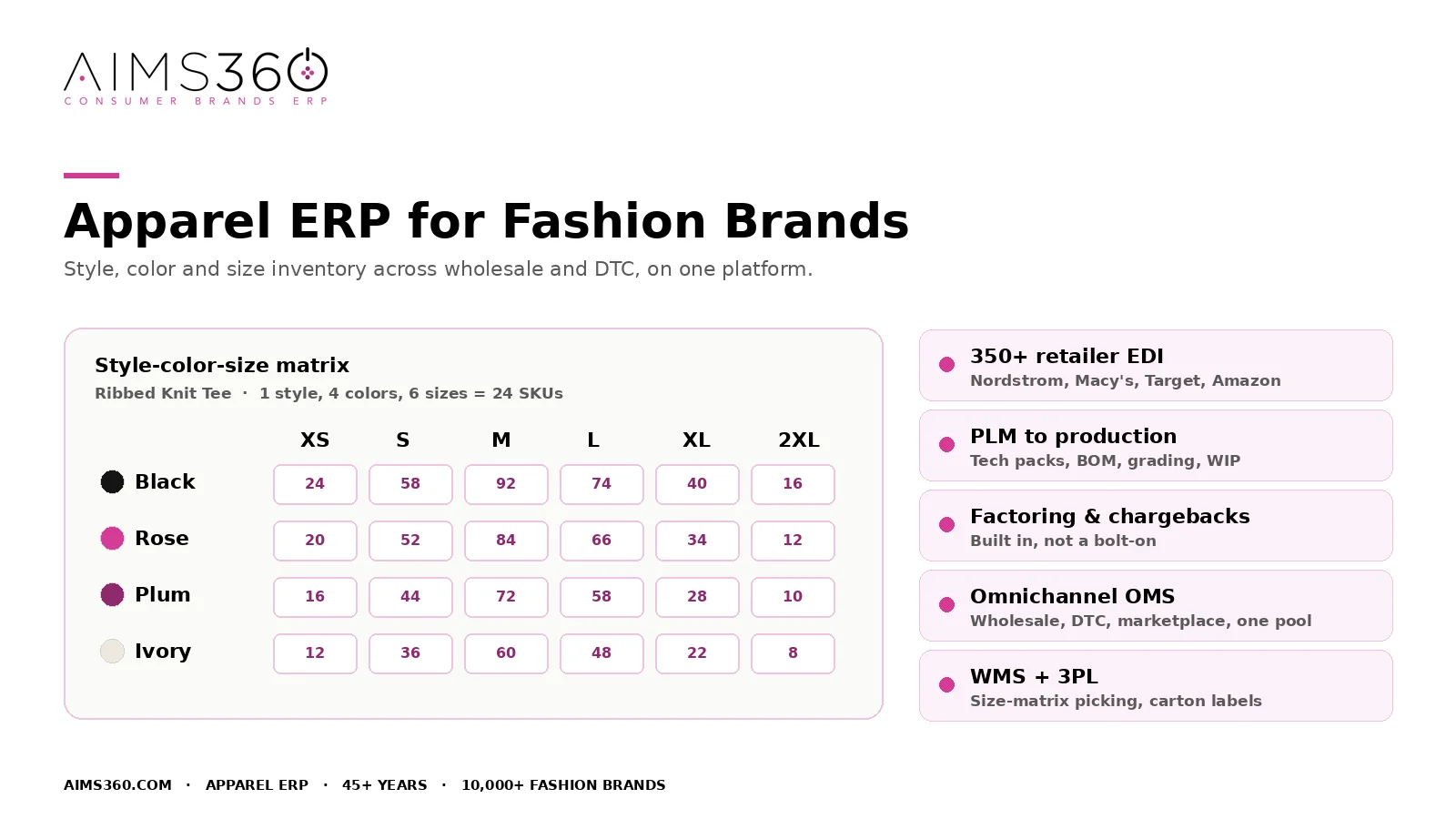
Apparel ERP style-color-size inventory matrix for a fashion brand, showing SKU quantities across sizes and colors with 350+ retailer EDI, PLM and omnichannel OMS in AIMS360.
AIMS360 manages the full style-color-size matrix for apparel brands: every size and color variant tracked as its own SKU, allocated across wholesale and DTC from one inventory pool.
  1. PLM: tech packs, BOM & samples

    Design, tech pack, BOM, sample tracking and approval workflow, all in one system. Production data flows downstream to the style master automatically. Explore PLM →

  2. Style master & PIM

    Every style carries size, color, season, fabric, fit, channel-level attributes and pricing. Syndicates to Shopify, Amazon, Joor, NuOrder and retailer portals. Explore PIM →

  3. Production: cut tickets, work orders & contractor POs

    Domestic and overseas production, contractor and factory POs, WIP tracking, sample yardage, landed cost rollup. Explore production →

  4. Retailer EDI to Nordstrom, Macy's, Target

    One managed connection per retailer. POs in, ASNs and invoices out, GS1-128 labels with routing guide compliance. Explore EDI →

  5. Omnichannel OMS

    Shopify, Shopify Plus, Amazon, Faire, Joor, NuOrder, B2B portals and retailer EDI, one OMS, one inventory pool. Explore OMS →

  6. WMS with pre-pack and matrix picking

    Inventory by location, by lot, by carton, by pre-pack. Pre-pack picking, assortment fulfillment, retailer-specific carton labeling. Explore WMS →

  7. 3PL integration

    Order, inventory, ASN, return and adjustment sync with major apparel 3PLs. Explore 3PL →

  8. Factor financing & chargeback dispute

    Wholesale invoices to CIT, Rosenthal, Hilldun, Wells Fargo automatically. Chargeback tracking with reason codes, evidence and dispute workflow.

  9. Payments, accounting & finance close

    Cards, ACH, factor activity, retailer remittance and full GL accounting. Monthly close becomes a process, not a forensic investigation.

Apparel workflow in AIMS360
1
Design & PLM
Tech pack, BOM, sample, approval
2
Production planning
Cut tickets, contractor POs, yield
3
Style master & PIM
Size, color, channel attributes
4
Order capture
Nordstrom, Macy's, Shopify, Amazon, Joor
5
Allocation: matrix + pre-pack
Channel rules, pre-pack assortment
6
Apparel inventory (WMS) pick + 3PL handoff
Carton labels, retailer routing
7
EDI: ASN, invoice, GS1
Per retailer spec, auto-sent
8
Factor + chargebacks
Invoice to factor, dispute workflow
9
Finance close
GL, remittance, monthly close
Retailer EDI for apparel brands

The retailer table for fashion & apparel

Category revenue context: A large share of AIMS360 brands sell into the elevated and contemporary channel, Nordstrom (roughly $15 billion in sales, now 49.9% owned by El Puerto de Liverpool), Saks Fifth Avenue, Neiman Marcus, Bloomingdale's, Revolve and Shopbop, alongside contemporary anchors like Anthropologie and Free People. The mass and off-price tiers add volume through Macy's ($22.2 billion US), Dillard's, Nordstrom Rack, Kohl's, TJX (T.J.Maxx, Marshalls, Sierra), Ross and Burlington, and the marketplaces (Amazon, Walmart) carry the highest raw unit counts. AIMS360 supports managed EDI to every one of these, from luxury department stores to mass volume accounts.

Every major apparel retailer requires EDI compliance before the first carton ships. Each has its own document spec, carton labeling standard, ASN timing window, routing guide and chargeback structure. Brands that manage this manually or through generic EDI services almost always hit a wall, chargebacks pile up, vendor scorecards fall, and reorder volume gets capped.

AIMS360 includes a fully managed EDI integration with every major apparel channel. POs flow directly from the retailer into the OMS, allocation runs against the matrix and pre-pack rules, ASNs generate to spec, GS1-128 carton labels print with the right encoding, and invoices submit on the retailer's window. Chargebacks are tracked at the document level with evidence so disputes have a record.

Department stores: Nordstrom, Macy's, Bloomingdale's, Saks Fifth Avenue, Neiman Marcus, Dillard's, Belk. The traditional luxury and contemporary channel for apparel. Documentation-heavy EDI with strict ASN timing and detailed routing guides.

Mass & value: Target, Walmart, Costco, JCPenney, Kohl's, Sam's Club. The volume channel for apparel and the most operationally demanding. Walmart's EDI is famously strict; Target's Perfect Order Program penalizes ASN errors directly; Costco requires pallet-level ASNs and specific pack-out rules.

Specialty & off-price: TJX (TJ Maxx, Marshalls, HomeGoods, Sierra), Ross, Burlington, Nordstrom Rack, Saks Off Fifth. Major channels for excess inventory and limited-distribution plays. Digital luxury and contemporary channels, Farfetch, Ssense, Net-a-Porter, Zappos and Shopbop, add another tier of specialty digital distribution with per-platform pack rules. AIMS360 supports the SKU pack-out and chargeback flow these retailers demand.

Children's & family specialty: Carter's, Children's Place, Babylist, Pottery Barn Kids, Pottery Barn Kids, Crate & Kids, Maisonette. Distinct retailer landscape for children's apparel.

International & DTC retailers: Anthropologie, Free People, Urban Outfitters, Revolve, Shopbop, Net-a-Porter, MatchesFashion, Selfridges, Harrods, Lane Crawford. AIMS360 handles international retailer EDI and the regional pack-out and labeling differences.

How AIMS360 compares

AIMS360 vs. the alternatives apparel buyers consider

Apparel buyers typically shortlist some combination of these. Here is the honest breakdown of where each fits, and where it doesn't.

AIMS360 vs. other apparel-vertical ERPs

Several apparel-vertical ERPs sit in the same conceptual category as AIMS360. The honest differentiation is breadth and depth. AIMS360 is the most-tenured apparel ERP in the market (40+ years), includes fully managed EDI to 350+ retailers as a native capability (not a third-party integration), includes built-in accounting (not a QuickBooks bolt-on), includes factor and chargeback management out of the box, and runs a US-based implementation team with 97.5% project success. Brands at meaningful scale or with multi-retailer EDI complexity typically end up at AIMS360.

AIMS360 vs. NetSuite, Acumatica, SAP Business One, Microsoft Dynamics

Horizontal ERPs that require significant customization, integration work and third-party add-ons to handle apparel workflows. NetSuite implementations for apparel routinely take 9-18 months and require ongoing consulting spend. The customization needed to handle matrix SKUs, pre-packs, retailer EDI, factor financing and seasonal costing turns into permanent technical debt. AIMS360 deploys faster, costs less to operate, and is built for these workflows natively.

AIMS360 vs. lightweight inventory and channel tools

Inventory and channel-management tools aimed at DTC-first SMB brands. They handle Shopify-led multichannel inventory well enough through a certain scale. They struggle the moment a brand lands real wholesale, multi-retailer EDI, factor financing, chargeback dispute workflow, or the need for true GL accounting. Most brands using these tools end up bolting on a separate ERP, separate EDI service, separate WMS and separate accounting, at which point one vertical ERP costs less than maintaining four disconnected tools.

AIMS360 vs. enterprise apparel ERP (Infor CloudSuite Fashion, SAP)

These are enterprise apparel ERPs aimed at large global brands with custom-everything budgets. Implementation timelines, license costs and ongoing operating costs make them inappropriate for the growth-stage to mid-market band. AIMS360 covers the same operational depth at a fraction of the cost, with a US-based team and a 97.5% implementation success rate.

AIMS360 vs. QuickBooks plus Shopify plus spreadsheets

The starting stack of every emerging apparel brand. It works until it doesn't. The breaking points are predictable: wholesale begins and EDI becomes manual portal work; a major retailer demands accurate ASNs and the team can't deliver; factor financing requires backup documentation that the stack can't produce cleanly; or revenue passes a threshold where channel margin is no longer trustworthy. AIMS360 is the platform brands move to at that inflection.

AIMS360 by role

What changes for each person on the apparel team

An apparel ERP is bought by a CEO or COO, but it gets used by everyone, design, production, sales, ops, finance, customer service. Here is what AIMS360 looks like from each chair.

For the founder, CEO and owner

One dashboard with channel margin, season P&L, cash position, factor advance, retailer chargebacks and inventory by category. Cash forecasting includes factor activity and retailer remittance windows so the owner sees real cash flow instead of accounting cash flow. The number every founder wants, true contribution margin by retailer and by season, is one click away and updated in real time.

For the COO and operations lead

Production, allocation, EDI, WMS, 3PL, returns and finance all flow through one platform with one set of permissions and one audit trail. SLA dashboards track retailer scorecards in real time. ASN error rates, ship-on-time percentages, EDI compliance metrics, chargeback dollars and dispute win rates are visible per retailer. The COO stops being the human integration layer between five tools.

For the design and PLM team

Tech packs, BOMs, fit comments, sample tracking, supplier collaboration and approval workflows in one PLM that flows directly into production. Designers see costing implications in real time as they spec garments. The handoff from design to production becomes a workflow step instead of a file transfer.

For the production manager

Cut tickets, work orders, contractor POs, WIP tracking, sample yardage, landed cost rollup and supplier scorecard, all in one production module. Domestic and overseas factories are managed in the same data model. The production manager sees what is in the pipeline, what is late, what is at-risk and what landed cost is doing to margin before goods arrive.

For the wholesale sales team and reps

Line sheets, showroom orders, buyer relationships, season calendars, retailer-specific pricing and bookings, all in one sales module. Reps in the field can write orders that flow directly into the OMS. Showroom appointments at MAGIC, Coterie, and Project capture orders on the floor with allocation against actual available inventory.

For the warehouse and 3PL team

Bin location management, lot tracking, pre-pack picking, matrix allocation, carton labeling, retailer-specific routing guide compliance, all native. Pickers receive matrix-aware pick lists. Carton labels print with the GS1-128 encoding each retailer demands. ASNs generate as cartons close. The warehouse stops being the EDI compliance bottleneck.

For the controller and finance team

Full GL with AP, AR, factor activity, retailer remittance, chargeback tracking and monthly close in one accounting module. No QuickBooks integration to maintain. No journal entries from a separate WMS. Cost of goods sold flows from production. Channel margin, season P&L and retailer-level profitability are first-class reports.

For customer service and returns

DTC returns, wholesale returns, retailer chargebacks, replacement orders, RMAs and credits, all tracked in one place with full order history. Customer service sees the order from the matrix down to the carton it shipped in. Returns process against the same inventory and accounting flow as outbound orders. No re-keying between systems.

Implementation

How AIMS360 implementation actually works for apparel brands

Most apparel brands have been burned by an ERP implementation. The story is almost always the same, a consulting partner sold the project, the timeline slipped, the customization grew, the budget doubled, and the team ended up running parallel systems for a year. AIMS360 implementations look different because the implementation team is AIMS360, not a third-party consultancy, and the methodology was built by apparel-industry operators rather than generalist consultants.

Phase 1, Discovery and scope (pre-signature): Before any contract is signed, the implementation team runs a structured discovery, channels, retailers, 3PLs, factor, accounting stack, headcount, SKU and order volumes, integration list, and delivers a Customer Success Proposal. The proposal includes specific implementation timing, integration scope, training plan and go-live date. The brand sees the project before they commit to it.

Phase 2, Data migration: Style master, customer master, vendor master, opening inventory, opening AR, opening AP, historical orders (as needed for reporting continuity). The data migration team works directly with the brand's IT or operations lead. Migration scripts are reviewed, tested and validated before any production cutover.

Phase 3, System configuration: Pre-packs, allocation rules, retailer scorecards, EDI specs per retailer, factor setup, accounting GL setup, channel pricing rules, season setup, costing rules. Every configuration choice is documented and reviewed with the brand operator before being committed to production.

Phase 4, Integration setup: Shopify, Amazon, Joor, NuOrder, Faire, retailer EDI connections, 3PL integration, payment gateway, factor connection, shipping carrier accounts, accounting bank feeds. Each integration is tested with real data before the next one is started.

Phase 5, Parallel testing and training: The brand runs AIMS360 in parallel with the existing system for a defined period. Training sessions are recorded and role-specific. Sales, production, ops, finance and customer service each get dedicated training tracks. The implementation team is on call throughout.

Phase 6, Go-live and stabilization: Cutover happens on a planned date with the implementation team on standby. Stabilization period of 30-60 days where the team is in active contact with the brand. Daily check-ins for the first week, weekly for the next several weeks.

Phase 7, Ongoing support: Post-go-live, the brand has a dedicated account team plus 24/7 emergency support. Quarterly business reviews check in on adoption, surface optimization opportunities, and plan for new retailers, channels or integrations.

The 97.5% project success rate reflects this methodology. The implementation team is not selling deliverables, they are operating a process built to make apparel brands successful on AIMS360.

The apparel market outlook

Why the operational layer matters more than ever for apparel

The apparel market has shifted from a pure-wholesale model to a DTC-first model to the current hybrid, where brands have to run both equally well or they lose to the brands that do. The brands that win the next five years are not the ones with the best product or the loudest marketing, those are necessary but not sufficient. The brands that win are the ones that can operate cleanly across wholesale, DTC, marketplace, B2B and retailer EDI simultaneously, with consistent inventory and consistent margin reporting across every channel.

The structural pressures on apparel brands have intensified. Tariffs and trade policy have made landed cost a real variable. Cotton and synthetic fiber pricing has moved meaningfully. Freight costs are no longer a rounding error. Retailer scorecards have tightened. Chargeback regimes have intensified. Off-price channels have become a planned distribution leg rather than an exit strategy. And the consumer side has fragmented, every brand has to be on Shopify, on Amazon, on Faire, on the right wholesale platform, and increasingly on TikTok Shop and social commerce. The brands running these channels manually or through duct-tape integrations cannot compete on margin with the brands running them through one platform.

The operational layer is the variable cost of being in the apparel business. A brand that pays 8-10% of revenue to operate its stack, five SaaS tools, an EDI service, a separate WMS, a part-time integration consultant, and the hidden cost of chargebacks and oversells, has 8-10% less margin than a brand running one platform. At meaningful revenue scale that difference is millions of dollars per year. It is the difference between a brand that can fund growth from cash flow and a brand that cannot.

This is the case for vertical ERP in apparel and the case for AIMS360 specifically. Forty years of building for this category mean the workflows are right, the EDI is right, the factor integration is right, the chargeback workflow is right, the season costing is right, and the implementation team understands the language before the brand says a word. The brands that win the next five years are the brands that decide to stop running operations as an integration problem and start running operations as a platform.

Who AIMS360 serves in apparel

From indie label to enterprise-scale brand operator

AIMS360 fits the brand on the way up and the manufacturer behind it. Most customers come on board around the inflection where QuickBooks plus Shopify plus spreadsheets stops working: wholesale begins, retailer EDI is required, or revenue passes a few million.

Contemporary women'sMen's apparelDenimActivewear & athleisureSwimwear & resortIntimates & lingerieBridal & formalSleepwear & loungeLuxury & designerStreetwear & casualChildren's & kids'Plus & extended sizingMaternityAdaptive apparelUniforms & workwearSustainable & recycledDomestic manufacturersPrivate label & PL producersImporters & distributors
Apparel operator trust

Apparel brands and manufacturers running on AIMS360

From indie labels to nine-figure brands processing high SKU and order volumes, across the apparel category spectrum.

Contemporary brand · Wholesale + DTC
AIMS360 replaced four disconnected systems and gave us one source of truth across PLM, inventory, EDI and accounting. Implementation moved faster than any ERP project we'd ever scoped, and 18 months in we're running 3× the volume on the same headcount.
Apparel brand COO
Denim · Retail-ready
We landed Nordstrom and Saks the same year. Without AIMS360's EDI, factor and chargeback tooling, that would have been impossible. The team understood the routing guides before we did.
Denim brand founder
Domestic manufacturer · Multi-brand
PLM, PIM, OMS and WMS in one stack means our production team and our brand customers are looking at the same data for the first time. Lead times dropped meaningfully.
Domestic apparel manufacturer
Children's brand · Specialty retail
Children's adds a layer of complexity, CPSIA, age-graded size runs, gift channels, that generic ERPs don't handle. AIMS360 does, and the implementation team understood our category from the first call.
Children's brand operator
Apparel buyer FAQ

What apparel brand operators and manufacturers ask

The questions buyers bring to discovery calls, answered directly.

What is the best ERP for fashion and apparel brands?
The best ERP for fashion and apparel brands is one built for how apparel brands actually run, size-color-style matrices, pre-packs, seasonal drops, wholesale into Nordstrom, Macy's, Bloomingdale's, Saks, Target and Walmart, DTC on Shopify and Amazon, a 3PL handling fulfillment, factor financing on wholesale receivables, and full retailer EDI compliance. AIMS360 is built for that operating model. Horizontal ERPs like NetSuite, Acumatica and SAP require significant customization and add-ons to handle apparel workflows.
Does AIMS360 handle children's and kids' apparel?
Yes. AIMS360 manages children's and kids' apparel SKUs including age-graded size runs (infant through 14), pre-pack and assortment management, CPSIA tracking for safety, seasonal and back-to-school cycles, and the retailer EDI for Nordstrom Kids, Macy's, Target, Carter's, and the registry channels like Babylist and Pottery Barn Kids. Children's apparel shares the apparel operating model with added safety documentation.
Does AIMS360 do EDI to Nordstrom, Macy's, Bloomingdale's and Target?
Yes. AIMS360 includes a fully managed EDI integration with the major apparel retailers, Nordstrom, Macy's, Bloomingdale's, Saks, Neiman Marcus, Target, Walmart, Costco, Dillard's, Kohl's, JCPenney, Belk, TJX and hundreds more. Purchase orders flow directly into the OMS, ASNs and invoices generate to each retailer's spec, and compliance documents like UCC-128 GS1 labels and routing guide compliance are produced automatically.
How does AIMS360 handle PLM and tech packs?
AIMS360's integrated PLM handles tech packs, bill of materials, grading rules, sample tracking, fit comments, supplier collaboration, cost engineering and approval workflows. The PLM data flows directly into production planning, purchase orders to factories, and the style master in the ERP. There is no separate PLM tool to integrate, it is one system.
Does AIMS360 support size-color-style matrix and pre-packs?
Yes. The size-color-style matrix is core to AIMS360, every style carries multiple colorways, each colorway has a size run, and inventory tracks by every SKU in the matrix. Pre-packs and assortments are first-class entities: brands define standard pre-packs and AIMS360 handles allocation, picking, ASN generation and finance against the pre-pack rather than the individual unit.
What about Shopify, Shopify Plus and Amazon for apparel DTC?
AIMS360 has native integrations with Shopify, Shopify Plus, Amazon Seller Central and Vendor Central including FBA, Faire, Joor, NuOrder, and most major DTC and B2B channels. Inventory is unified across DTC, wholesale, marketplaces and Amazon FBA against a single source of truth. Channel allocation rules prevent oversells when wholesale POs land against the same inventory pool.
How does AIMS360 compare to newer apparel software platforms?
Newer apparel software platforms tend to cover DTC and light wholesale well. AIMS360 has been built specifically for apparel for 45+ years and adds the capabilities newer tools usually lack: fully managed EDI to 350+ retailers, built-in accounting, factor and chargeback management, 24/7 emergency support included, and a 97.5% implementation success rate with a US-based team. Brands scaling past meaningful wholesale typically end up at AIMS360.
How does AIMS360 compare to NetSuite for apparel brands?
NetSuite is a horizontal ERP requiring significant customization and third-party add-ons to handle apparel workflows. AIMS360 is built for these workflows out of the box, deploys faster, costs less to implement and maintain, and is run by an apparel-industry team. NetSuite implementations for apparel brands routinely take 9-18 months.
Does AIMS360 support factor financing and chargeback management?
Yes. AIMS360 integrates directly with major apparel factors, CIT, Rosenthal, Wells Fargo, Hilldun, Capital Business Credit and others, so wholesale invoices flow to the factor automatically. Chargebacks from retailers are tracked at the document level with reason codes, evidence and dispute workflow. Most apparel brands cut their unrecovered chargeback exposure significantly within the first year on AIMS360.
Does AIMS360 work for emerging fashion brands or only enterprise?
AIMS360 serves apparel brands from emerging to enterprise. Many customers come on board around the inflection where a brand outgrows QuickBooks plus Shopify plus spreadsheets, typically when wholesale begins, when retailer EDI is required, or when annual revenue passes a few million. The platform scales from there to nine-figure brands processing high SKU and order volumes.
How does AIMS360 handle production and overseas manufacturing?
AIMS360 handles cut tickets, work orders, BOMs, contractor and overseas factory POs, WIP tracking, costing by season and style, sample tracking, landed cost calculation and full supply chain visibility from raw materials through finished goods. Domestic and overseas production are managed in the same system with the same data model.
How long does AIMS360 implementation take for an apparel brand?
AIMS360 implementations for apparel brands typically run weeks to a small number of months, depending on the number of channels, retailers, 3PLs, and data migration scope. The implementation team scopes the project before signature, delivers a Customer Success Proposal, then handles data migration, system configuration, EDI and channel setup, testing, training and go-live. The 97.5% project success rate reflects a team built from apparel-industry operators rather than generalist consultants.
What apparel categories does AIMS360 support?
AIMS360 supports the full apparel category range: contemporary women's, men's, denim, activewear, athleisure, swimwear, intimates and lingerie, bridal and formal, suiting and tailored, sleepwear and lounge, outerwear, luxury and contemporary, streetwear, sustainable and direct-to-consumer brands, plus children's and kids' apparel, school uniforms, and uniforms and workwear.
What is apparel management software?
Apparel management software is the system a clothing brand runs its operations on: style, color and size inventory, purchase orders and production, wholesale and DTC orders, retailer EDI, warehouse or 3PL fulfillment, and accounting. The term is used interchangeably with apparel ERP. AIMS360 has been the apparel management software of record for fashion brands and manufacturers for 45+ years, with 10,000+ brands run on the platform.
What is the best apparel ERP software?
The best apparel software depends on your size and channels. Enterprise houses with big budgets run SAP or NetSuite with heavy customization. Small sellers get by on inventory apps. For growing brands and manufacturers selling wholesale and DTC, AIMS360 is the purpose-built option: style-color-size inventory, 350+ retailer EDI connections, PLM, 3PL and Shopify in one platform, implemented in-house with a 97.5% success rate. Book a demo and compare it against your shortlist.
What is apparel accounting software?
Apparel accounting software is a general ledger built for how clothing brands actually get paid: wholesale invoices, factor advances, retailer chargebacks and deductions, DTC settlements, and landed cost on imported goods. Most brands bolt QuickBooks onto a separate inventory system and reconcile by hand. AIMS360 includes accounting natively, so the same order that ships to Nordstrom posts to the general ledger without a second system.
What is apparel wholesale software?
Apparel wholesale software runs the B2B side of a clothing brand: line sheets, seasonal and at-once orders, sales rep territories and commissions, pre-packs and size runs, retailer EDI, allocation across accounts, and chargeback tracking. DTC tools do not cover any of it. AIMS360 runs wholesale and DTC from one inventory pool, with managed EDI to 350+ retailers built in.
What is fashion inventory management software?
Fashion inventory management software tracks stock at the style, color and size level instead of as one SKU line. A single tee in 4 colors and 6 sizes is 24 distinct units to receive, allocate, pick and reorder. It also handles pre-packs, size runs, work in progress from production, and allocation across wholesale, DTC and marketplace channels. AIMS360 was built on matrix inventory from day one.
What software does the apparel industry use?
The software for the apparel industry runs on four things: PLM for design and tech packs, ERP for inventory, orders and finance, EDI for retailer compliance, and a WMS or 3PL for fulfillment. Large houses buy those separately and pay integrators to connect them. AIMS360 is apparel business software and fashion industry software that combines all four in one platform, which is why 10,000+ brands and manufacturers run on it.
What is fashion management software?
Fashion management software, also called fashion business software, is the operating system for a clothing brand: product development, style-color-size inventory, wholesale and DTC orders, production and purchasing, retailer EDI, warehousing and accounting. The term overlaps almost entirely with apparel ERP. AIMS360 has been the fashion management software of record for 45+ years, with a 97.5% implementation success rate and a US-based team. Book a demo to see it.
What are the best apparel ERP systems?
The ERP apparel software systems most brands evaluate are AIMS360, NetSuite, and enterprise platforms like SAP or Infor CloudSuite Fashion. Enterprise systems fit large houses that can fund an 18-month custom build. Generic cloud ERP needs heavy configuration before it understands size and color. AIMS360 is the purpose-built option: style-color-size inventory, 350+ retailer EDI connections, PLM, factoring and 3PL in one system.
AIMS360

The apparel ERP that wholesale buyers actually use.

See AIMS360 configured for your category, your retailers, your channels, your SKU complexity, your factor, your 3PL. A 30-minute call gets you a walkthrough on your data. See the fashion ERP software running 10,000+ consumer brands.