Explore AIMS360's apparel business software
FREE DEMO
Industries we serve

ERP software for 10 consumer brand industries

One platform that runs your wholesale, your DTC, your retailer EDI, your 3PL and your accounting, configured for the operational reality of your category. Brands and manufacturers across fashion, beauty, footwear, jewelry, outdoor, wellness, home, home care, baby and pet, all on AIMS360.

AIMS360
Wholesale + DTC. 10 industries. One platform.
45+
Years in market
10
Industries
350+
Retailer EDI integrations
Why vertical ERP matters

Generic ERP fails consumer brands. Vertical ERP doesn't.

Horizontal ERPs, the SAPs, NetSuites and Acumaticas of the world, were designed for manufacturing, distribution and services in the abstract. They handle a SKU. They do not handle a SKU that has 12 shades, 4 sizes, an expiration date, a Sephora EDI spec, a 3PL pick path, a Shopify variant, an Amazon ASIN and a B2B portal price tier, all on the same row in the same week.

AIMS360 was built for exactly that. The platform speaks the language of style, color, size, shade, lot, batch, season, channel and retailer. It connects PLM, PIM, OMS, WMS, CRM, EDI, payments, shipping and accounting in one system, and it is configured per industry so the workflows match how brands and manufacturers actually run, not how a generic ERP wishes they did.

97.5%
Implementation success rate
Faster go-live vs. legacy ERP
24/7
Emergency support, included
45+
Years of EDI, Shopify, production & ops expertise
Built for consumer brands

Choose your industry

Every AIMS360 deployment is configured to the operational reality of one of these ten industries. Click any card to see the platform, integrations, retailers and features tailored to that vertical.
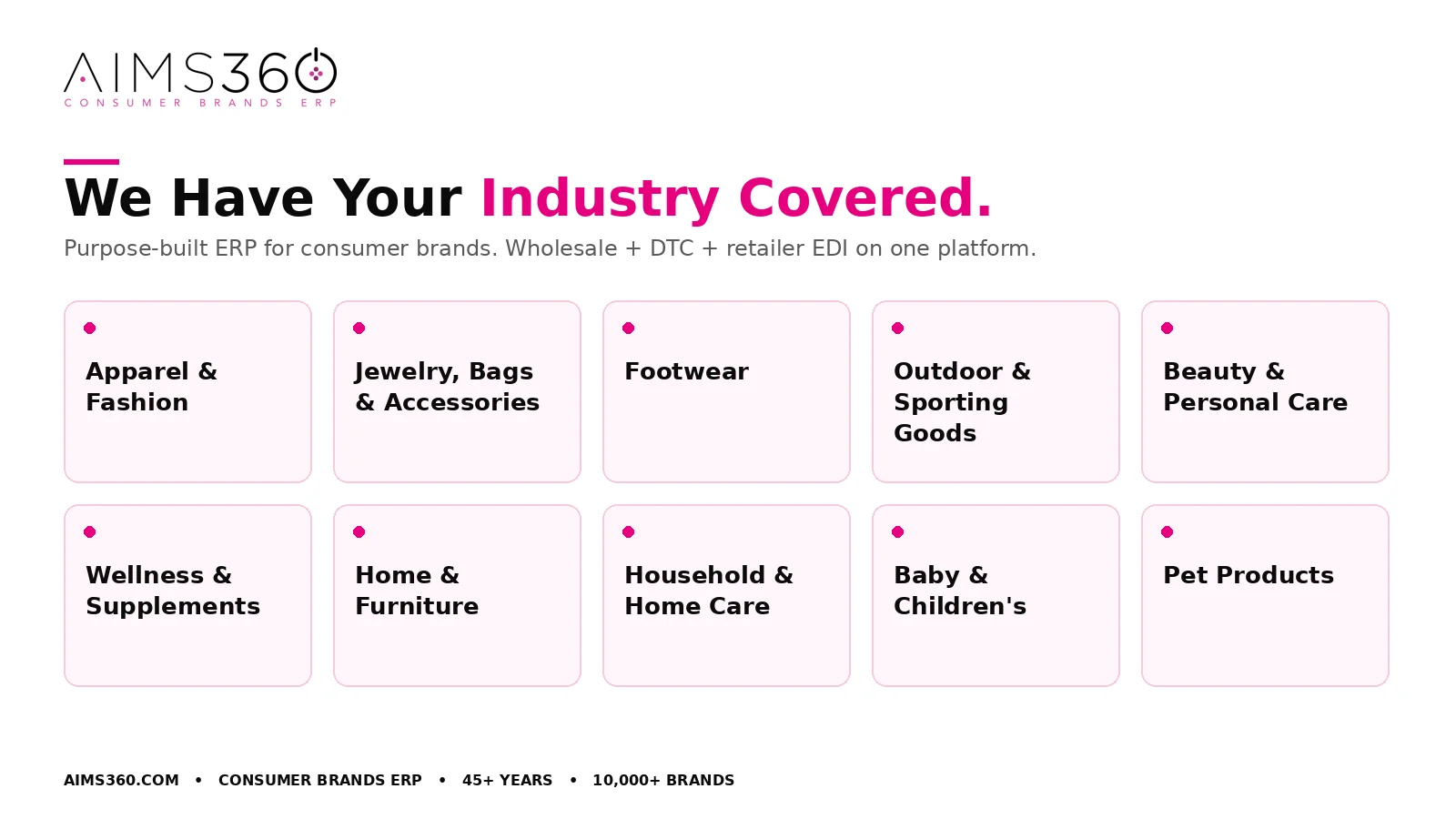
AIMS360 Consumer Brands ERP covers ten industry verticals, Fashion & Apparel, Jewelry Bags & Accessories, Footwear, Outdoor & Sporting Goods, Beauty & Personal Care, Wellness & Supplements, Home & Furniture, Household & Home Care, Baby & Children's Products, and Pet Products.
One vertical ERP built for ten consumer brand categories, powering 10,000+ brands with retailer EDI, DTC subscription, compliance and inventory in a single platform.
01 / FASHION

Fashion & Apparel

Apparel, denim, activewear, swim, intimates, bridal, suiting, sleepwear, luxury and children's apparel, from indie labels scaling DTC to growth-stage brands entering wholesale and major retail.

Top retailers: Nordstrom, Saks Fifth Avenue, Neiman Marcus, Bloomingdale's, Revolve, Shopbop, Anthropologie, Free People, Macy's, Dillard's, Zappos, Nordstrom Rack, Kohl's, Target, Walmart, Amazon.

Style-color-size complexity Chargebacks & EDI compliance Seasonal cash flow Wholesale vs. DTC inventory conflicts
Explore industry
02 / JEWELRY

Jewelry, Bags & Accessories

Fine and fashion jewelry, watches, leather goods, handbags, luggage and accessories, where material costs, valuation and channel mix demand operator-grade controls.

Top retailers: Neiman Marcus, Saks Fifth Avenue, Nordstrom, Bergdorf Goodman, Blue Nile, Net-a-Porter, Signet (Kay, Zales, Jared), Pandora, Macy's, QVC, HSN, Amazon.

High-value shrinkage control Serialized & memo inventory Made-to-order tracking Metal & stone cost swings
03 / FOOTWEAR

Footwear

Athletic, casual and fashion footwear, operationally distinct from apparel in sizing depth, sourcing and the retail-versus-DTC margin equation.

Top retailers: Nordstrom, Saks Fifth Avenue, Neiman Marcus, Bloomingdale's, Revolve, Zappos, Foot Locker, Dick's Sporting Goods, Journeys, DSW, Famous Footwear, Nordstrom Rack, Amazon.

Size-run depth & pre-packs High return rates Core-size stockouts Wholesale + DTC allocation
04 / OUTDOOR

Outdoor & Sporting Goods

Outdoor, technical apparel, gear and sporting goods, where technical materials, gear-plus-apparel SKU complexity and specialty retail dynamics shape the business.

Top retailers: Dick's Sporting Goods, REI Co-op, Backcountry, Moosejaw, Bass Pro Shops + Cabela's, Public Lands, Academy Sports, Scheels, Hibbett Sports, Amazon.

Pre-season buy risk Technical BOM complexity Carryover inventory Warranty & repair tracking
Explore industry
05 / COSMETICS & BEAUTY

Cosmetics, Beauty & Personal Care

Cosmetics, skincare, color, fragrance, haircare and personal care, the operational complexity of formulation, regulation and channel-by-channel margin.

Top retailers: Sephora, Nordstrom, Saks Fifth Avenue, Neiman Marcus, Bluemercury, Space NK, Credo, Ulta Beauty, Bloomingdale's, Nordstrom Rack, Target, CVS, Amazon.

Expiration & lot tracking Sephora & Ulta chargebacks Samples & GWP draining stock Shade SKU proliferation
Explore industry
06 / WELLNESS

Wellness & Supplements

Supplements, functional nutrition and wellness brands, where compliance, claims and subscription unit economics demand operator-grade rigor.

Top retailers: Whole Foods, Costco, Erewhon, Sprouts Farmers Market, Thrive Market, The Vitamin Shoppe, GNC, iHerb, Trader Joe's, CVS, Amazon, Walmart.

FDA labeling & claims risk CoA & lot traceability Expiry write-offs Subscription demand forecasting
07 / HOME

Home, Furniture & Lifestyle

Home goods, housewares, furniture, upholstery, lighting, lamps, home decor and lifestyle brands, where freight economics and big-box retailer dynamics make or break the business.

Top retailers: RH, Williams-Sonoma, Pottery Barn, West Elm, Crate & Barrel, Arhaus, Anthropologie Home, Nordstrom, Bloomingdale's, Wayfair, Ashley Furniture, HomeGoods, Target, IKEA, Amazon.

Oversized freight & damage Landed cost accuracy Drop-ship complexity Long production lead times
08 / HOME CARE

Household & Home Care

Eco cleaning, laundry, dish, surface, and air care brands, formulation, lot and batch tracking, retailer compliance and refill subscription economics.

Top retailers: Erewhon, Whole Foods, Grove Collaborative, Thrive Market, Sprouts Farmers Market, Credo, Target, Kroger, Costco, CVS, Walmart, Amazon.

Ingredient disclosure (AB 1783) Lot & batch recalls Retailer compliance specs Refill & subscription ops
09 / BABY & KIDS

Baby & Children's Products

Baby gear, feeding, sleep, toys, gifts and children's lifestyle brands, safety testing, registry channels and specialty retail shape every operational decision.

Top retailers: Nordstrom, Saks Fifth Avenue, Neiman Marcus, Maisonette, Disney, Bloomingdale's, Pottery Barn Kids, Babylist, Nordstrom Rack, Target, Kohl's, Costco, Walmart, Amazon.

CPSIA testing & recalls Safety documentation Registry channel ops Fast size turnover
10 / PET

Pet Products

Pet food, treats, pet supplies, toys, accessories, supplements and wellness, where AAFCO compliance, specialty distribution and subscription economics define the operating model.

Top retailers: Chewy, specialty and independent pet boutiques, Petco, PetSmart, Tractor Supply, Costco, Target, Walmart, Amazon, plus distributors (Central Garden & Pet, Phillips Feed, Pet Food Experts).

AAFCO & food compliance Autoship demand forecasting Cold chain & expiry Multi-bag SKU complexity
Cross-industry capabilities

One platform. Every workflow a consumer brand needs.

AIMS360 ships with the full operating stack out of the box. No bolted-on third-party billing for the basics, no separate inventory tool, no shadow EDI vendor.

Buyer's guide

How to choose an ERP for a consumer brand

Most brands start looking at one of three moments: wholesale begins, a retailer demands EDI, or the QuickBooks-plus-Shopify-plus-spreadsheets stack finally breaks. Here is what actually matters when you evaluate.

Does it handle your product's real structure?

A generic ERP treats a product as one line. A consumer brand product rarely is. It has size, color, shade, fill, lot, batch, expiration, season and pack configuration. Ask any vendor to show you a matrix order-entry screen. If they can't, the tool was not built for you, and you will fight it for years. AIMS360 was built on style, color and size inventory from day one.

Is EDI native, or bolted on?

Retailers like Nordstrom, Target, Sephora and Dick's do not care that EDI is hard. They send a spec, expect compliance, and charge back when you miss. A platform with managed EDI is the difference between shipping on time and eating a chargeback. Ask who maps the documents and what happens when a spec changes.

Does one inventory pool serve every channel?

Wholesale, DTC, marketplace and subscription should draw from the same inventory with allocation rules, not four silos you reconcile by hand. If a platform keeps Shopify stock separate from wholesale stock, you will oversell one and sit on the other. A real omnichannel OMS allocates against a single pool.

Who runs the implementation?

The software matters less than the team that turns it on. A platform implemented by a consultancy that learned your industry last quarter is a risk. AIMS360 implementations are run in-house by people who have operated consumer brands, and the 97.5% success rate shows it. Ask any vendor for their number and who does the work.

Vertical vs. horizontal ERP

Why a vertical ERP beats a horizontal one for consumer brands

A horizontal ERP, NetSuite, SAP, Acumatica, Dynamics, is a blank platform. It can be configured for almost any business, which sounds like a strength until you price the configuration. To make one handle apparel or beauty, you hire a systems integrator, build custom fields for size and shade, buy a separate EDI tool, buy a separate 3PL connector, and spend twelve to eighteen months and six figures before your first order ships. Then you own the maintenance forever.

The horizontal path

Generic ERP

NetSuite, SAP, Acumatica, Dynamics

  • Hire a systems integrator to configure it
  • Build custom fields for size, shade and lot
  • Buy a separate EDI tool
  • Buy a separate 3PL connector
  • Own the custom maintenance forever
12-18months and six figures before your first order ships
The vertical path

AIMS360

Purpose-built for consumer brands

  • Matrix inventory (style, color, size, shade, lot) in the box
  • Managed retailer EDI included
  • 3PL, Shopify, factoring and lot tracking built in
  • Configured per industry, not coded from scratch
  • Maintained by AIMS360, not your budget
Weeksto go live, with a 97.5% implementation success rate

A vertical ERP is the opposite bet. AIMS360 is a consumer brands ERP, pre-configured for how consumer brands actually run. Matrix inventory, retailer EDI, 3PL, Shopify, factoring, wholesale terms, DTC subscription and lot tracking are in the box, not on a quote. You configure per industry, expiration tracking for beauty and supplements, size depth for footwear, safety documentation for baby products, AAFCO compliance for pet, but you configure a system that already speaks your language.

The tradeoff is worth stating plainly. A horizontal ERP flexes into industries AIMS360 does not serve. If you run a chemical plant or a hospital, buy the horizontal platform. But if you run a consumer brand, what analysts call CPG or consumer packaged goods, selling physical product through wholesale and DTC, a purpose-built platform gets you live faster, costs less to own, and does not need a consultant on retainer to change a price tier.

Operator trust

Brands across every category run on AIMS360

Indie labels, growth-stage brands, established wholesalers and domestic manufacturers, operating across ten industries, on one platform.

Fashion · Wholesale + DTC
AIMS360 replaced four disconnected systems and gave us one source of truth for inventory, EDI and accounting. Implementation moved faster than any ERP project we'd ever scoped.
Apparel brand operator
Beauty · Retail-ready
We onboarded Sephora and Ulta EDI in weeks, not months. The team understood the retailer specs before we did.
Beauty brand founder
Multi-category · Manufacturing
PLM, PIM, OMS and WMS in one stack means our production team and our sales team are looking at the same data for the first time.
Domestic manufacturer
Industry FAQ

What buyers ask before choosing AIMS360

What industries does AIMS360 ERP serve?
AIMS360 serves ten consumer brand industries: fashion and apparel; jewelry, bags and accessories; footwear; outdoor and sporting goods; beauty and personal care; wellness and supplements; home, furniture and lifestyle; household and home care; baby and children's products; and pet products. Within each industry AIMS360 supports brands, private label operators, distributors, importers and domestic manufacturers.
Is AIMS360 only for apparel companies?
No. AIMS360 was built for apparel and the architecture, style, color, size and lot tracking, multi-channel order management, retailer EDI, 3PL integration and consolidated wholesale plus DTC operations, applies cleanly to beauty, footwear, jewelry, outdoor gear, wellness, home goods, household care, baby and children's products and pet brands. The same operating model works across all consumer brand verticals.
Can AIMS360 handle beauty and cosmetics SKUs?
Yes. AIMS360 manages cosmetics, skincare, fragrance, haircare and personal care SKUs including shade variants, size and fill variants, lot and batch tracking, expiration and best-by dates, sample and GWP inventory, and the retailer EDI compliance required by Sephora, Ulta, Target, CVS, Nordstrom and Walmart.
Does AIMS360 connect to retailer EDI for non-apparel categories?
Yes. AIMS360 includes a fully managed EDI integration that connects to hundreds of retailers across consumer brand categories: Nordstrom, Saks Fifth Avenue, Neiman Marcus and Bloomingdale's for elevated fashion, jewelry and children's; Sephora, Bluemercury and Nordstrom for prestige beauty, then Ulta, Target and CVS for mass; REI, Backcountry and Dick's Sporting Goods for outdoor; Whole Foods, Sprouts, The Vitamin Shoppe and GNC for wellness and supplements; Maisonette, Pottery Barn Kids and Babylist for baby; specialty boutiques, Chewy, Petco and PetSmart for pet; and Walmart, Target, Costco and Amazon for mass volume across all categories.
Does AIMS360 support both DTC and wholesale?
Yes. AIMS360 is one of the few vertical ERPs built equally for DTC and wholesale. The omnichannel OMS unifies Shopify, Shopify Plus, Amazon, Faire, B2B portals and EDI retailer orders against a single inventory pool, with allocation rules so wholesale commitments and DTC demand do not collide.
Does AIMS360 work for early-stage brands or only enterprise companies?
AIMS360 serves brands from emerging to enterprise. Many customers come on board around the inflection point where a brand outgrows QuickBooks plus Shopify plus spreadsheets, typically when wholesale begins, when retailer EDI is required, or when annual revenue passes a few million. The platform scales from there to nine-figure brands.
How long does AIMS360 implementation take?
AIMS360 implementations average significantly faster than legacy ERPs. The implementation team scopes the project before signature, delivers a Customer Success Proposal, then handles data migration, system configuration, channel and integration setup, testing, training and go-live. The 97.5% project success rate reflects a team built from industry operators rather than generalist consultants.
What features are included across every AIMS360 industry?
Every AIMS360 deployment includes the full feature stack, PLM, PIM, OMS, WMS, CRM, EDI, sales, shipping, payments, accounting, reporting, AI automations and cloud hosting. Specific configurations and workflows are tailored to each industry, for example, expiration and lot tracking for beauty, wellness and household care; size depth strategy for footwear and children's apparel; safety testing documentation for baby; and AAFCO compliance for pet food.
What expertise does the AIMS360 implementation team bring?
The AIMS360 implementation team brings deep operator expertise in the workflows that define consumer brand operations: EDI with every major retailer (Nordstrom, Macy's, Bloomingdale's, Saks, Target, Walmart, Costco, Sephora, Ulta, REI, Dick's, Whole Foods, Sprouts, Vitamin Shoppe, GNC, Petco, PetSmart, Chewy and 350+ more), Shopify and Shopify Plus configuration with subscription and B2B tooling, production and contract manufacturing workflow including PLM, BOM and tech packs, and high-volume order processing across DTC, wholesale, marketplace and subscription channels running against one inventory pool. Implementation is run by AIMS360 directly, not a third-party consultancy, with a 97.5% project success rate.
What is the best ERP software for consumer brands?
The right ERP depends on your operating model. Horizontal platforms like NetSuite, SAP and Microsoft Dynamics fit companies that can fund long custom builds. For brands selling wholesale and DTC, a vertical ERP like AIMS360 includes matrix inventory, retailer EDI, 3PL and Shopify integration out of the box, so you go live in weeks instead of 12 to 18 months. AIMS360 has run 10,000+ consumer brands over 45+ years on that model.
What are the essential ERP modules for a direct-to-consumer brand?
A DTC consumer brand needs seven core modules: inventory with style, color, size or lot detail; order management connected to Shopify and marketplaces; warehouse management or 3PL integration; purchasing and production; accounting; CRM; and retailer EDI for the day wholesale starts. AIMS360 ships all seven in one platform, so nothing gets bolted on later.
How much does ERP implementation cost for a mid-sized consumer brand?
Horizontal ERP implementations for mid-sized consumer brands usually run six figures and 12 to 18 months once integrator fees, custom fields and separate EDI tools stack up. AIMS360 costs less because the work is already done. We spent 45+ years building these retailer connections and made the early mistakes on our own dime, so you are not funding a provider learning the ropes on your project. Implementations are scoped before signature, run in-house, and hold a 97.5% success rate. For consumer brands in these industries, that is the best ROI of any ERP, smaller tools or enterprise platforms included.
How is CPG inventory software different from general inventory software?
General inventory tools track a SKU as one line. Consumer brand inventory carries lot, batch, expiration, size, color, shade and pack configuration, and it has to allocate across wholesale, DTC and marketplace channels at once. Purpose-built systems like AIMS360 handle matrix and lot-tracked inventory natively, which is why CPG operators outgrow generic tools like QuickBooks or Zoho Inventory.
What features matter most in inventory software for brands with complex SKUs?
Six features separate real consumer brand inventory software from the rest: matrix inventory (style-color-size), lot and expiration tracking, multi-warehouse and 3PL visibility, channel allocation rules, barcode scanning, and native retailer EDI. AIMS360 includes all six, plus omnichannel order management that draws every channel from a single stock pool so you never oversell one channel while sitting on inventory in another.
Is AIMS360 a CPG ERP?
Yes. AIMS360 is a CPG ERP for the brand side of consumer packaged goods: companies that sell finished products through retail, wholesale and DTC. It covers CPG inventory management with lot, batch and expiration tracking, retailer EDI, forecasting and one stock pool across every channel. If you searched for a consumer products ERP or consumer packaged goods ERP and mostly found plant-floor manufacturing systems, AIMS360 is the alternative built for brands and the 10 consumer industries on this page.
AIMS360

Stop running your brand on five disconnected tools.

If your team is reconciling Shopify against QuickBooks against the 3PL against an EDI portal, you already know what this costs you. A 30-minute call shows you what one platform looks like for your category, your retailers and your channels. No demo deck. Just your actual operating model on screen. See the fashion ERP software running 10,000+ consumer brands.