Ask ChatGPT about your AIMS360 orders, invoices, sales, and margin in plain English. AIMS360 is a plugin published in the ChatGPT directory and reviewed by OpenAI, so there is no developer mode to enable. Read-only, so nothing in your ERP can be changed from chat.

The AIMS360 plugin for ChatGPT connects the assistant your team already uses to the ERP that runs your business. Ask about orders, sales, margin, or who owes you money in plain English, and ChatGPT answers from live AIMS360 data as a summary, a sortable table, a chart, or an Excel export. It is published in the ChatGPT directory and reviewed by OpenAI, so nobody has to switch on developer mode to use it. AIMS360 is a consumer brands ERP used by brands in fashion and apparel, footwear, jewelry, bags and accessories, cosmetics, beauty and personal care, outdoor and sporting goods, wellness and supplements, home, furniture and lifestyle, household and home care, baby and children's products, and pet products.
Book a demo Open the AIMS360 plugin in ChatGPTYes. AIMS360 publishes a plugin in the ChatGPT directory that gives the assistant read-only access to your live orders and invoices. You ask a question in plain English, such as what did we sell last month by customer, which orders are past due, or top 20 styles by units this season, and ChatGPT returns the answer from your actual AIMS360 data, with the option to see it as a table, a chart, or an Excel file. Nothing in your ERP can be changed from the chat.
The practical difference is who gets to ask. Reporting in most ERPs is a skill: you have to know which report, which filters, which date field. With the plugin, anyone who can type a sentence can get the number. A sales rep asks which accounts are behind on payment. A planner asks what has no allocation. A CFO asks for margin by division against last year. Same data, no training required.
There are two ways to get an ERP into ChatGPT, and they are not equally safe. The other way is to add a raw MCP server yourself in developer mode. OpenAI's own developer documentation carries an elevated risk label on that mode and tells builders to watch for prompt injection, model mistakes on write actions that could destroy data, and malicious MCP servers that try to steal information. It is meant for developers who know how to configure and test connectors safely.
AIMS360 went the other route. The plugin is published in the ChatGPT directory, which means OpenAI reviewed it before anyone could turn it on.
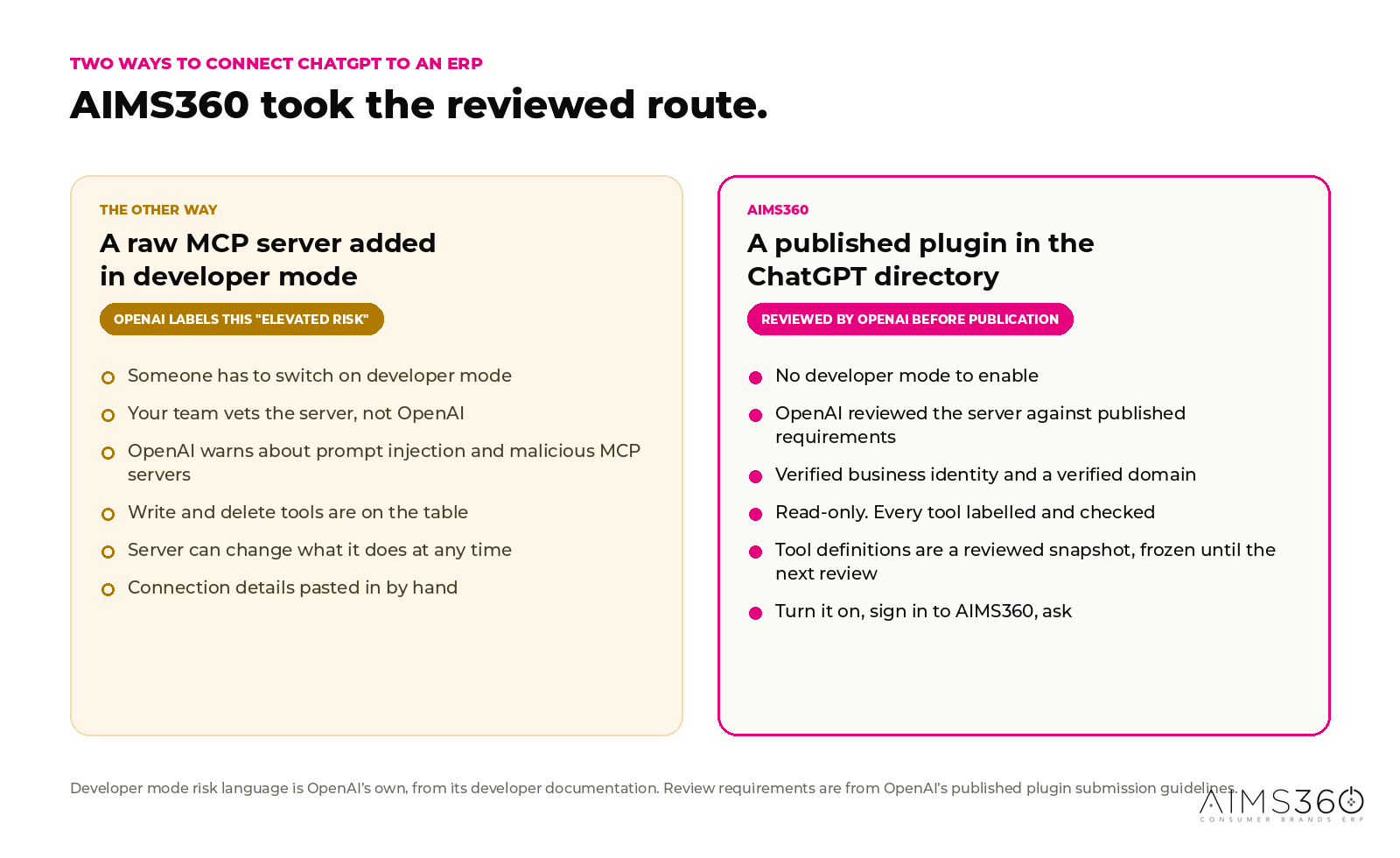
Your team never has to enable the mode OpenAI flags as elevated risk. And because the AIMS360 plugin is read-only, there is no write, delete, or send tool for an injected instruction to reach for. Prompt injection is not solved by anyone, but the tools that would make it dangerous are absent.
OpenAI reviews the MCP server, the tool definitions, and the read-only and destructive labels on every tool. Incorrect action labels are one of the most common reasons a submission is rejected, so the read-only claim on this page is one OpenAI checked rather than one AIMS360 asserted.
Public submissions require a verified business identity, and reviewers confirm it matches the listed name, website, support contact, privacy policy, and terms. AIMS360 also had to prove control of the domain hosting the server by publishing a token on it. You can see who you are connecting to before you connect.
OpenAI publishes the tool metadata captured at review. Changing what the tools are, or what they claim to do, means submitting a new version for review. A server you added yourself can change behaviour tomorrow with nobody re-checking it.
A published plugin is something a workspace admin can review and approve through ChatGPT's own plugin controls, with the publisher identity, privacy policy, and permissions in front of them. A self-added connector pushes that decision onto whoever pasted in the URL.
Published plugins live in one directory used by both ChatGPT and Codex. People can browse or search for AIMS360, mention it by name in a conversation, or pick it from the tools menu, rather than needing a link and a setup guide from us.
Two minutes of the AIMS360 plugin for ChatGPT answering real questions against real orders and invoices, including what the table, chart and Excel output look like.
The AIMS360 plugin for ChatGPT, reading live orders and invoices. Read-only throughout.
ChatGPT is good at understanding what you meant. AIMS360 is the only thing that knows what is true about your orders, your units, and your money. The integration keeps each one doing what it is good at.
Understanding plain-English business wording. Resolving last quarter, my top accounts, the fall line. Follow-up questions without starting over. Turning the result into a summary, a table, or a chart, and drafting the email around it.
Live orders and invoices from your own tenant, at style, color and size grain. Booked versus shipped kept separate so sales means the right thing. Margin percent, average unit retail, units back-ordered. Every channel: DTC, wholesale, retail, and EDI dropship.
No data warehouse to build, no extract to schedule, no BI seat to buy, and no developer mode to enable.
Open the AIMS360 listing in the ChatGPT directory and enable it for yourself or your workspace.
The plugin authenticates against your own AIMS360 tenant. You see your data and nobody else's.
No query language, no field names, no report builder. AIMS360 resolves business wording to the right fields.
Read it, open it as a table, chart it, or export the whole thing to Excel.
These are not canned reports. They are examples of wording that works, because AIMS360 resolves business language to the right fields behind the scenes. Follow-ups chain naturally: pull the top customers, ask which of their orders are unallocated, then export the list.
Prefer Claude or Grok? The same ERP data is available through the AIMS360 MCP server for Claude and the MCP server for Grok. For a standing dashboard use Power BI, and for the finance file use Live Excel.
The plugin exposes read-only tools over your live AIMS360 data. Orders cover the booked side of the business; invoices cover what shipped and sold. Every tool is labelled read-only in the metadata OpenAI reviewed.
| Area | Break it down by | Measure it in |
|---|---|---|
| Orders Booked and open backlog |
Customer, style, color, size, style/color/size, season, division, sales rep, ship-to state, order source, payment terms, carrier, buyer, vendor, cancellation reason, entered / start / complete date | Ordered amount, open amount, shipped amount, cancelled amount, order count, units booked, units cancelled |
| Invoices Shipped, sold and billed |
Customer, style, color, size, style/color/size, season, division, sales rep, bill-to and ship-to state, order source, Shopify store, payment terms, carrier, invoice date, due date | Total amount, merchandise, balance, invoice count, units shipped, units back-ordered, margin %, average unit retail |
| Record lookup One order or invoice |
Order number or invoice number, with line-item and per-size expansion | Full header and line detail, allocations, back-order position |
Built-in shortcuts cover what operators ask most: overdue orders, orders with no allocation, overdue invoices, and outstanding balance. Period-over-period comparison is built in as well, so this month against last, or the same month across three years, does not need a new report.
| ChatGPT on its own | ChatGPT + AIMS360 | |
|---|---|---|
| Source | Whatever you remembered to paste in | Live AIMS360 orders and invoices |
| Grain | None | Style, color, size, season, division |
| Booked vs shipped | Ambiguous | Separated, so sales is unambiguous |
| Year over year | Only if you supply both periods | Built in, up to 12 periods |
| Output | Text | Text, table, chart, or Excel |
| Setup | None, and no data either | Turn on a reviewed plugin, sign in |
| Risk of a wrong figure | Real | The figure is retrieved, not generated |
The catalogue of reviewed, published plugins that ChatGPT and Codex share. A plugin can contain skills, an MCP server, or both. AIMS360 is the MCP kind.
The ChatGPT setting that lets someone add a raw MCP server themselves. OpenAI labels it elevated risk and intends it for developers testing connectors. AIMS360 does not require it.
Model Context Protocol. An open standard for connecting AI assistants to external systems, created by Anthropic and now governed by the Agentic AI Foundation under the Linux Foundation.
A label on each tool saying whether it only reads, can change things, or can do something irreversible. OpenAI reviews these and rejects submissions where they are wrong. Every AIMS360 tool is read-only.
An attack where instructions hidden in content the assistant reads try to make it act against the user. An open problem across the industry. Read-only tools limit what such an instruction could accomplish.
Booked is what was ordered. Shipped is what left and was invoiced. Consumer brands need both, and they are not the same number.
Stock or work-in-progress committed to an order. Open orders with none are backlog at risk.
Average unit retail. Total dollars divided by units sold, at whatever grain you asked for.
Yes. AIMS360 publishes a plugin in the ChatGPT directory that connects the assistant to your live AIMS360 orders and invoices. Turn it on, sign in with your AIMS360 account, and ask questions in plain English. ChatGPT answers from your real ERP data instead of guessing. AIMS360 also runs MCP servers for Claude and Grok.
No, and that is the point. Developer mode is how you add a raw MCP server to ChatGPT yourself, and OpenAI's own developer documentation labels it elevated risk, telling builders to watch for prompt injection, model mistakes on write actions, and malicious MCP servers that try to steal information. AIMS360 is a published plugin instead, so nobody at your company has to switch that mode on to get ERP answers in ChatGPT.
Yes. Every plugin in the ChatGPT directory goes through OpenAI's review before it can be published. Review covers the MCP server itself, the tool definitions and their read-only and destructive labels, the privacy policy, data minimization in tool responses, and a verified business identity for the publisher. AIMS360 also had to prove control of the domain hosting the server. Being reviewed is not the same as being endorsed. OpenAI does not endorse the apps in its directory, and AIMS360 does not claim it does.
No, and be wary of any vendor who says otherwise. Prompt injection is a live research problem for every AI assistant that reads outside content, and directory review does not make it go away. What being in the directory changes is the size of the target. Your team does not have to enable a mode OpenAI itself flags as elevated risk, the server was reviewed against published requirements rather than vetted by you alone, and because the AIMS360 plugin is read-only there is no write or delete tool for an injected instruction to reach for.
No. The AIMS360 plugin is read-only. It can look up and analyze orders and invoices, but it cannot create, edit, cancel, or delete anything in AIMS360. Every tool it exposes is labelled read-only in the metadata OpenAI reviewed, and OpenAI treats incorrect action labels as a common reason to reject a submission. Your controls, approvals, and audit trail stay exactly where they are.
Yes. A published plugin is something a workspace admin can review and approve through ChatGPT's own plugin controls, using the listing's publisher identity, privacy policy, support contact, and permissions. The alternative, a self-added developer-mode server, pushes that judgment onto whoever pasted in the connection details.
Not quietly. OpenAI stores the tool metadata discovered when the plugin was scanned and publishes that reviewed snapshot. Changing what the tools are or what they claim to do means submitting a new version for review. That is a meaningful difference from a self-added server, which can change behaviour any time without anyone re-checking it.
Plugin, and the naming has gone back and forth. OpenAI retired the original 2023 plugin store, replaced it with apps built on the Apps SDK, and has since consolidated on plugins again, with a single Plugins Directory shared by ChatGPT and Codex. A plugin can contain skills, an MCP server, or both. AIMS360 is the MCP kind. If you search for a ChatGPT plugin for an ERP, this is the thing you are looking for.
Anything that maps to orders or invoices. Total sales last month, top customers by dollars, top styles or sizes by units, sales by season, division, sales rep, or ship-to state, open order backlog, orders with no allocation, overdue orders, overdue invoices, outstanding balance by customer, margin percent and average unit retail by style, and any of those against the prior period or the same period last year.
All of them. Ask for a summary and you get a written answer. Ask to see the list and you get a sortable table. Ask to chart it by month and you get a bar, line, or donut chart. Ask to export to Excel and you get an XLSX download. For a standing dashboard, use Power BI. For the finance file, use Live Excel.
A dashboard answers the questions someone anticipated when they built it. ChatGPT on top of AIMS360 answers the question you have right now, including the follow-up. There is no report to request, no filter set to rebuild, and no waiting on a report writer. For scheduled recurring output, AIMS360 reporting still does that job.
That is governed by your own ChatGPT plan and workspace settings, not by AIMS360. OpenAI's business plans are not used to train models by default. AIMS360 sends only the rows a question needs, never a full export, and OpenAI's plugin rules require tool responses to leave out anything not relevant to the request. Confirm the specifics for your plan before rolling it out company-wide.
Same ERP, different front doors. ChatGPT gets a reviewed plugin from the directory. Claude and Grok connect over an MCP server AIMS360 provisions for your tenant, because those assistants use a custom connector model rather than a reviewed public directory. All three are read-only. Every connection is listed on the AI assistants hub.
Yes. The data behind it is your AIMS360 ERP, which already covers DTC, wholesale, retail, and EDI dropship to major retailers in one system, so the numbers cover every channel rather than one storefront. AIMS360 is a consumer brands ERP used by brands in fashion and apparel, footwear, jewelry, bags and accessories, cosmetics, beauty and personal care, outdoor and sporting goods, wellness and supplements, home, furniture and lifestyle, household and home care, baby and children's products, and pet products.
Open the AIMS360 listing in the ChatGPT directory, turn it on, and sign in with your AIMS360 credentials. There is nothing to install, no connection string to paste, and no developer mode to enable. If you want help rolling it out to a team, book a demo and we will walk it through on your own orders and invoices.
Book a demo and we will run it against your catalog and your channels: a question in plain English, an answer straight out of AIMS360, and the rows behind it.
Book a demo See pricing


