

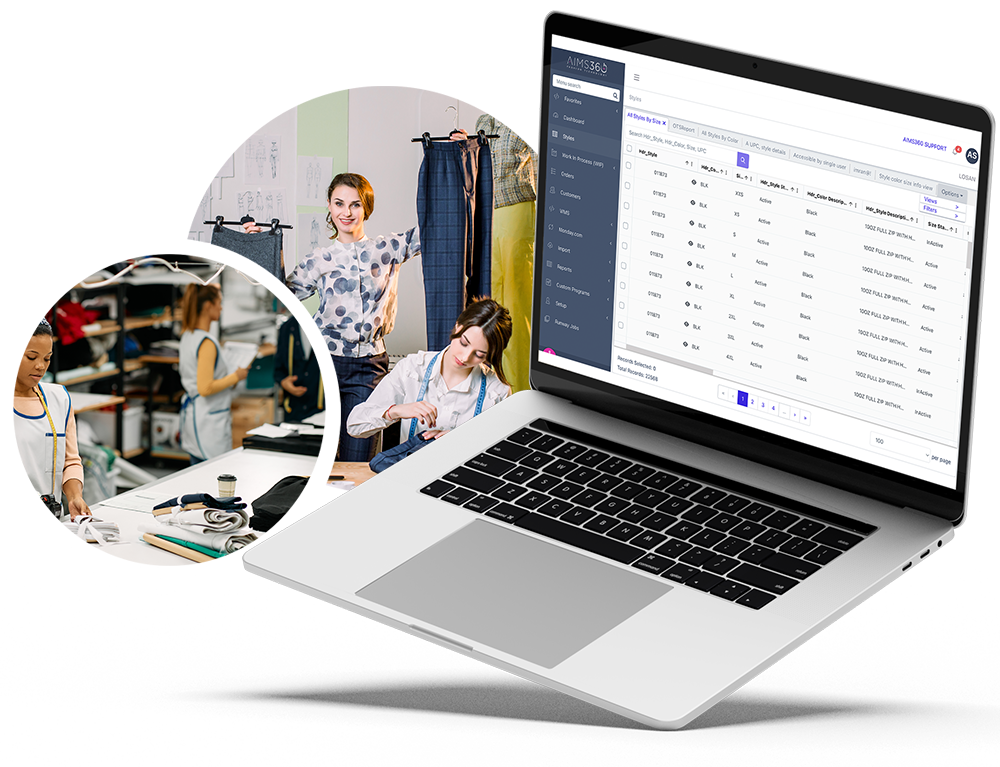
Apparel production management software: the BOM, the cut ticket and the units actually on the floor
Product development and production live in the same record as your inventory, your orders and your books. The bill of materials is the recipe your margin is calculated from, the cut ticket reads it, and production tracking holds a quantity at every stage rather than a checkbox. When the goods land they are costed from the recipe that made them.
Does AIMS360 have a PLM, or do I need one?
AIMS360 carries the product development records a small team needs without a separate PLM: styles and colors, the size matrix, the bill of materials, raw material and trim inventory, costing, vendor management, production tracking and a spec sheet generated from the style record. Design, 3D rendering, tech pack authoring and fit rounds run in a connected PLM such as Centric PLM, WFX or BeProduct, and the approved style flows into AIMS360 from there.
Most brands under a certain size never buy a PLM, and that is a reasonable decision rather than a gap. A PLM starts to earn its keep when design headcount, sample rounds and supplier collaboration outgrow what a style record can hold. The question worth asking is not whether you have a PLM but where approval happens, because approval is the moment a style stops being a development project and becomes a product.
Who owns the style, and when
The two systems get confused because both hold a style. The difference is which version of it. A PLM holds the style while it is still changing; the ERP holds it once it is a sellable, purchasable, countable thing.
Native in AIMS360
- Styles and colors with the size matrix
- The bill of materials: fabric consumption, trims, labor operations
- Raw material and trim inventory, by lot, roll and location where it matters
- Costing, rolled up from the BOM rather than typed beside it
- Vendor management for factories, contractors, mills, dye houses and printers
- Vendor purchase orders and cut tickets
- Production tracking and work in process, by quantity
- A spec sheet generated from the style record
What a PLM adds
- Sketches, CADs, 3D and line plans
- Tech packs, measurement specs and construction authoring
- Sample rounds, fit comments and approval workflows
- Supplier collaboration on materials and costing
- Colorway and material libraries at design scale
When you need these, the PLM integration hands the approved style across and AIMS360 takes it from there.
The bill of materials is the recipe your margin lives in
Every fabric with how much of it one garment consumes, every trim, and the labor operations. Fabric plus trims plus labor is the style's cost before freight and duty, and everything the sales team negotiates later sits on top of that number.
Fabric, with consumption
Consumption is where costing lives or dies. A marker that yields a few percent worse than planned changes the cost of every unit in every colorway.
Trims, all of them
Buttons, zippers, interlinings, labels, thread, hangtags, polybags. Individually they cost cents, a style usually carries a dozen or more, and forgetting one won't make it free. It just makes your cost sheet wrong.
Labor operations
Cutting, sewing, washing, finishing, whether in your own shop or priced per operation by a contractor. Labor is often the biggest single line and the one that changes most between costing and reality.
The rollup
The cost sheet is calculated from the BOM rather than typed in beside it, so when a fabric price changes or a contractor rate moves, the cost follows. A new colorway starts from the existing recipe instead of a blank spreadsheet.
Count units, not checkboxes
Every system claims production tracking. The question that separates them is what gets stored when goods move.
| What the system stores | What you can answer | What you cannot |
|---|---|---|
| A date per step | When a step started or was marked finished | How many units it applied to, or what is still sitting there |
| A checkbox or status per step | That a step is done. Fine for an approval, wrong for a cut | Anything about a run that is half done, which is most runs most of the time |
| A quantity per step, by style, color and size | How many units are at each stage right now, which sizes are behind, what you can honestly promise a buyer | Nothing about the position, though it is only as current as the last person to record a move |
Gates and stages are different shapes
A gate is an approval where nothing physical moves: RFQ sent, contractor approved, first fitting, marker and grading, final QC sign off. Done or not done is honest there. A stage is where the goods are, and stages carry quantities.
Build the steps your floor actually has
Name the steps, decide which ones carry goods, set dependencies, assign a vendor per step, attach tasks to people and mark where the BOM is issued. Domestic cut and sew, full package import, and denim and washed goods are three different templates.
Imported production has stages too
Ex-factory, on the water, in customs, on transport. The shipping stage carries its real date, the paperwork travels with the job, and receiving reconciles against what was actually expected.
WIP feeds what you can promise
The work in process figure produced by quantity tracking feeds availability, so allocation and your sales team are working from goods that are genuinely coming rather than goods someone hopes are coming.
One connected chain, not five systems that agree on Fridays
Each step below reads the one before it. That is the whole argument for keeping production in the ERP rather than beside it.
| Step | What reads what |
|---|---|
| 1. The style exists | Style and colors with the size matrix, and a spec sheet generated from the record. |
| 2. The BOM is built | Fabric with consumption, trims, labor. The cost rolls up and the wholesale price is set against it. |
| 3. Purchasing buys the recipe | The BOM tells purchasing what to order. Vendor purchase orders go out with full apparel detail, and landed cost is tracked rather than assumed from the factory price. |
| 4. Materials arrive as inventory | Fabric and trims land as raw material inventory, by lot, roll and location where that matters. |
| 5. The cut ticket reads the BOM | It knows what it consumes. Contractors and work in process stay visible while the goods are out of the building. |
| 6. Finished goods land, costed | Costed from the recipe that produced them, into inventory and out through every order channel, with the numbers reaching accounting without a reconciliation pass. |
Three production shapes, one module
How much of this you use depends on what you actually make and where.
You cut and sew
Here or with contractors. You need the full chain: BOM, raw material inventory, cut tickets, contractor work in process and finished goods costed from the recipe.
You import full package
The factory buys the materials. You still need the BOM for costing and the stages between ex-factory and your dock, with landed cost and customs in the picture.
You decorate blanks
Screen printing, embroidery, garment dye, heat transfer, sublimation and embellishment. Source garments map to finished goods so the blank leaves inventory and the decorated style arrives with its decoration cost in it.
Across ten consumer brand industries the fields differ, but the shape stays the same: a recipe, a purchase, a production run tracked by quantity, and goods that arrive knowing what they cost.
What each part of production and PLM does
Each one has its own page with the detail, the limits and the questions brands actually ask.




Common questions
What brands ask when they are deciding whether product development belongs in the ERP or in a separate system.
AIMS360 carries the product development records a small team needs without a separate PLM: styles and colors, draft styles and samples, the size matrix, bills of materials, raw material and trim inventory, costing, vendor management, production tracking, and a spec sheet generated from the style record. Design, 3D, tech pack authoring and fit rounds are handled by a connected PLM such as Centric PLM, WFX or BeProduct, with the approved style handed to AIMS360 for production.
Which version of the style each one holds. The PLM holds the style while it is still changing: sketches, CADs, tech packs, measurement specs, sample rounds, fit comments, colorway and material libraries. The ERP holds it once it is a sellable, purchasable, countable thing: the style, color and size matrix with inventory, purchase orders to factories and material vendors, production tracking, work in process, and the orders, invoicing and accounting that follow. Approval is the line between them.
Not to start. The style master, BOM, costing, vendor management, spec sheets and production tracking in AIMS360 carry product development for most brands. When design headcount and sample rounds grow, AIMS360 integrates with Centric PLM, WFX and BeProduct.
Tech packs are authored in a connected PLM or by your design team and stored in AIMS360 against the style, the order or the cut ticket, so the pack travels with the production record. AIMS360 also generates a spec sheet from the style record covering measurements, bill of materials, construction and images, and that spec sheet travels with the purchase order and the cut ticket.
The recipe for one garment: every fabric with how much of it a single unit consumes, every trim from buttons and zippers to labels, thread, hangtags and polybags, and the labor operations such as cutting, sewing, washing and finishing. Fabric plus trims plus labor rolls up to the style's cost before freight and duty, which is the number your wholesale price and your margin sit on top of.
The cost sheet is calculated from the BOM rather than typed in beside it, so when a fabric price changes or a contractor's rate moves, the cost follows. Costing a new colorway or a revised version of last season's body starts from the existing recipe instead of a blank spreadsheet, and configured products roll up their own cost and margin per configuration.
Because a run almost never moves as one block. Fabric relaxes late, one size runs short, a contractor takes half the bundles and comes back for the rest on Thursday. A date tells you when something happened and a checkbox tells you that it happened; neither can tell you how many units it applied to. Tracking a quantity per step, by style, color and size, is what lets you say how many units are at each stage right now and which sizes are behind.
A gate is an approval or confirmation where nothing physical moves, such as an RFQ sent, a contractor approved, a first fitting or a marker and grading sign off. Done or not done is the honest answer for those. A stage is where the goods actually are, such as cutting, sewing, bundling, finishing or receiving, and those carry quantities. Using the right shape for each is what separates a production board you can trust from one that merely looks tidy.
They are the same record rather than three systems. The style master feeds the BOM, the BOM tells purchasing what to buy and what a cut ticket consumes, production tracking holds the quantity at each stage per size, and the work in process figure that produces feeds availability, so a sales rep is quoting against goods that are genuinely coming. When finished goods land they are costed from the same recipe and flow into wholesale, EDI, direct to consumer and marketplace orders on one stock record.
Yes. Domestic cutting, sewing, bundling, finishing and receiving are stages you build to match your own floor, and imported production adds the stages between the factory and your dock: ex-factory, on the water, in customs and on transport. The shipping stage carries its real date, the paperwork travels with the job, and receiving reconciles against what was actually expected rather than against a hope.
Both. Fabric and trims are carried as raw material inventory, by lot, roll and location where that matters. The cut ticket reads the BOM to know what it consumes, contractors and work in process stay visible while the goods are out, and finished goods land costed from the recipe that produced them.
Yes. Screen printing, embroidery, garment dye, heat transfer, sublimation and embellishment are handled by mapping a source garment to the finished good it becomes, so the blank leaves inventory and the decorated style arrives with the decoration cost in it, rather than the two living as unrelated items.
Where production fits
Last reviewed 16 September 2026 by the AIMS360 team. Native product development scope reflects the AIMS360 configuration as of that date and is confirmed for your setup during implementation. Product and company names belong to their owners.
Bring a style you are costing right now
We will build its bill of materials, roll up the cost, raise the vendor purchase order and walk a run through cutting and sewing with half the units moved, so you can see what the board says when a job is genuinely half done.


