
A prepack is a size breakdown that speeds up order entry and never moves physical stock. A case pack is a style number of its own with its own inventory. A bundle is an offer whose availability is derived from the items inside it. AIMS360 handles all three, and keeps them apart.
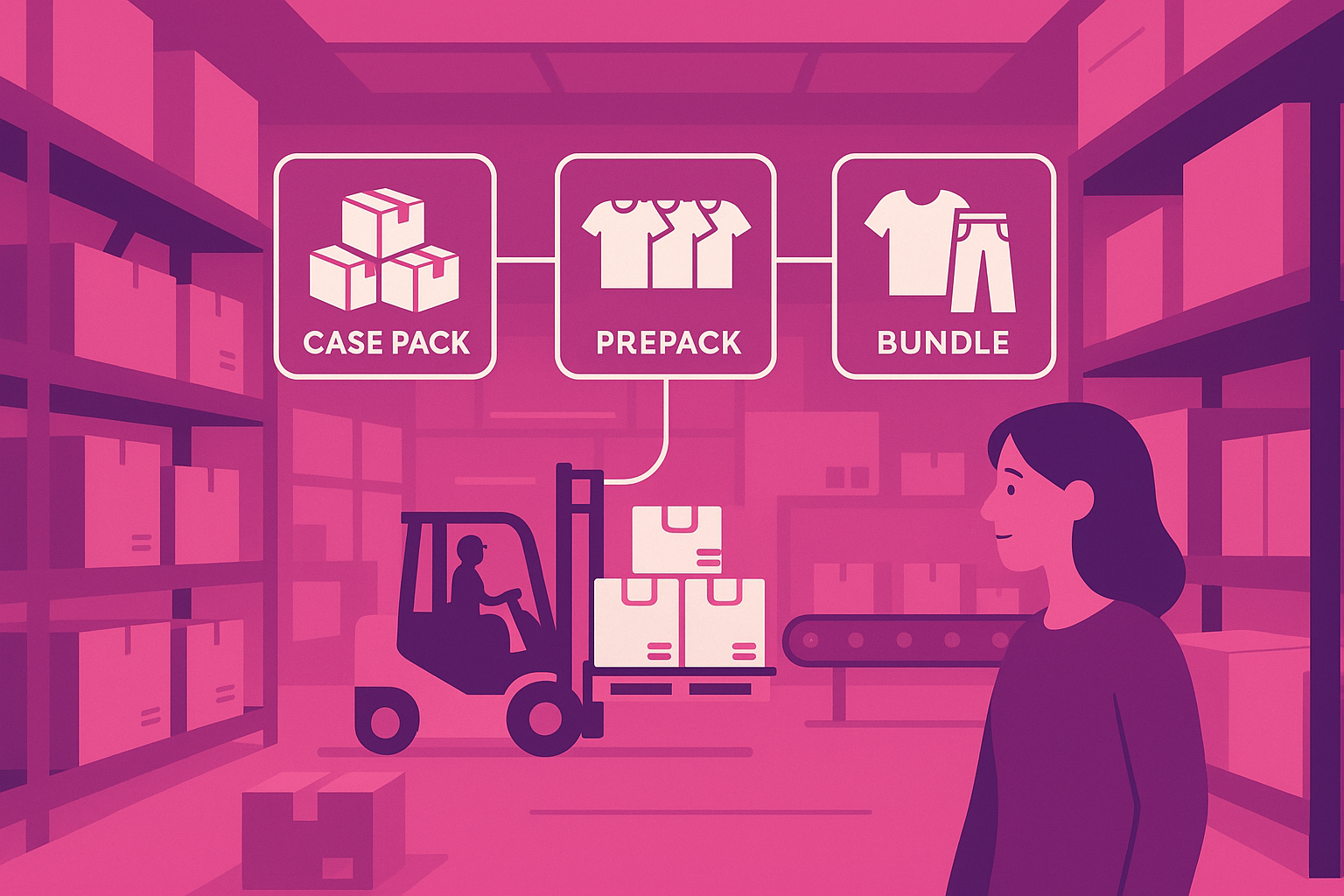
They get used interchangeably in conversation and they behave nothing alike in a system. A prepack is a size breakdown that makes order entry fast and never touches physical stock. A case pack is a style number of its own with its own inventory. A bundle is an offer whose availability is worked out from the items inside it. Getting them mixed up is how brands end up adjusting stock by hand every week.
A prepack is a shortcut. A case pack is a product. A bundle is a calculation. A prepack is a predefined quantity per size that speeds up order entry and does not move physical goods. A case pack is a style number in its own right, representing an assembled pack, holding its own inventory and sold as a style. A bundle is a multi unit offer whose available quantity is derived from the stock of the items it contains, so nothing is committed until it is fulfilled.
A quantity per size, set up against the size scale. A 1 2 2 1 or a 2 2 2 1 becomes a code, and a salesperson orders three of them instead of typing eight numbers.
Inventory effect: none. The units are ordinary loose units.
A distinct style number standing for a specific packing of styles and units. Sold as a style, picked as a style, counted as a style.
Inventory effect: it has its own stock figure, and packing consumes the loose units.
Several units of the same or closely related items sold together at a promotional price. A three pack of tees. Configured at the point of ordering, not assembled in advance.
Inventory effect: availability is derived from the components and stays in step both ways.
If you want the longer commercial version of this comparison, we wrote one up separately: case pack vs prepack vs bundles. What follows here is how each one behaves in the system.
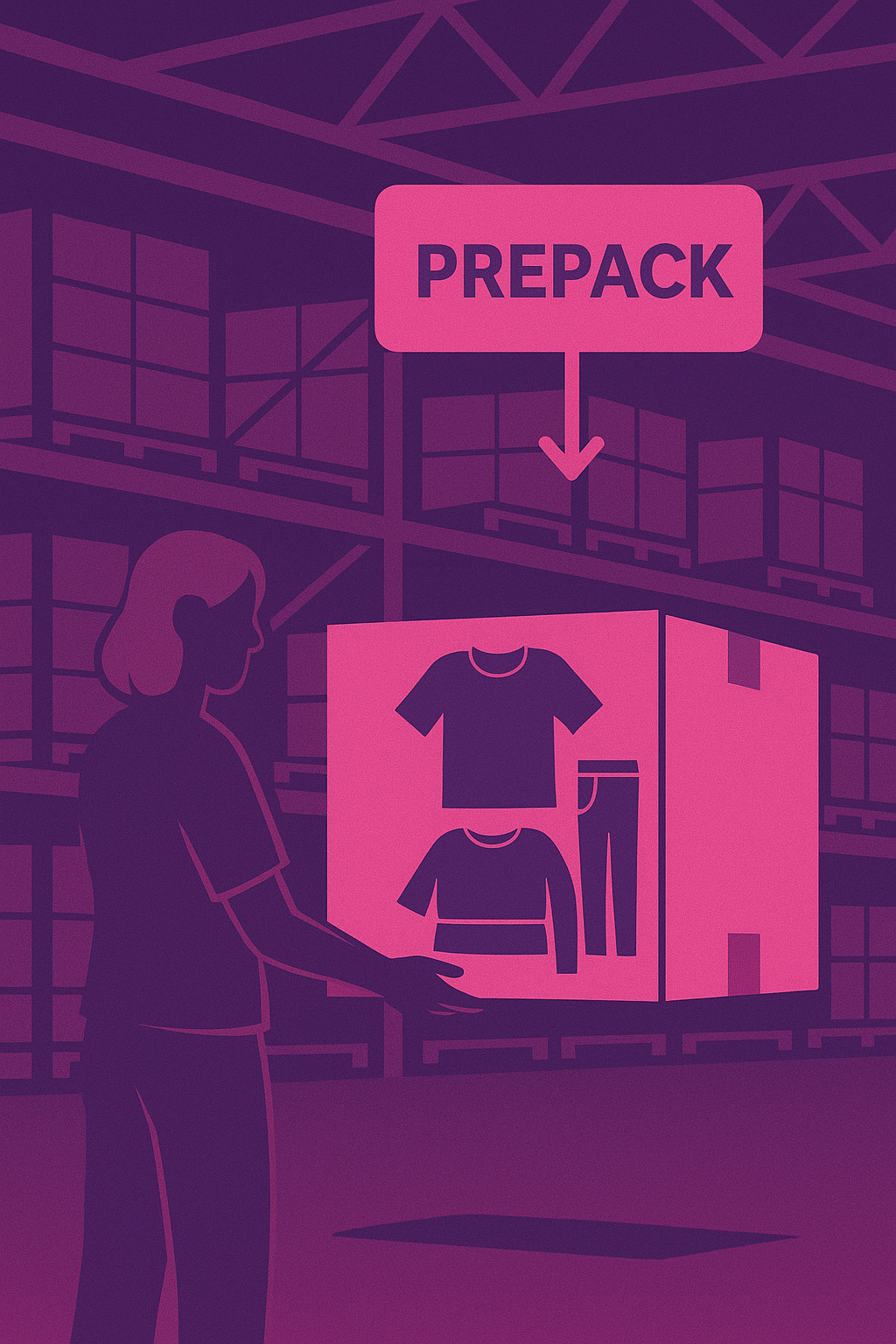
A prepack does not represent a physical packing of goods. This is the part that trips people up, and it is worth being blunt about. A prepack is a set of individual units taken in a pre agreed size breakdown, purely so an order can be entered quickly and a minimum can be enforced. Nothing gets boxed. Nothing gets set aside. The stock is exactly the loose stock it was before.
Prepacks are configured against the size scale, not the style, so every style using that scale can use them. You get up to 26 prepacks per size scale, coded A to Z, each one holding a quantity for each size in the scale.
The commercial reason to use them is that they are how wholesale actually gets sold. A buyer does not want to think in units, they want six of that style in the usual run. A prepack turns that into a single line, and it stops the order coming in as five larges and nothing else. Prepack pricing can be set as well, so a size run can carry its own price rather than being priced unit by unit.
A case pack in AIMS360 is a unique style number that represents a packing of specific styles and units.
Because the case pack is a style, everything that already works for a style works for it: it goes on a customer order, it allocates, it picks, it ships and it invoices. Nothing special has to be built around it.
The case pack carries its own stock figure, distinct from the loose units inside it. When you are shipping to a club or a bulk program, the case is what gets counted, and that is the number that has to be right.
Pack a case pack from existing inventory, and the units convert out of the individual sizes and into the case pack style. Case pack work in progress is tracked too, so a run of cases being built is visible rather than a gap.
Cases can be unpacked back into loose units. That matters the week a bulk order gets cut and you would rather sell the contents individually than sit on assembled cases you cannot move.
Case packs are also where case level barcodes come in. A case or inner pack is identified by a GTIN 14, a different number from the GTIN 12 on the garment inside, which is what lets a warehouse receive or ship the case without opening it. Since the case pack is a style, it can carry its own identifier the same way any other style does.
A bundle is configured when the order is placed, not assembled in advance, so the stock of the individual items should not be consumed the moment the bundle is created. What you want to know is simply how many bundles you could build right now, and that is a calculation, not an adjustment.
The calculation takes the limiting component. For each item in the pack, divide the available stock by the quantity the pack needs and round down. The pack availability is the lowest result across all of them.
| Component | Needed per pack | Available | Packs possible |
|---|---|---|---|
| 123 BLK S | 1 | 10 | 10 |
| 123 BLK M | 2 | 15 | 7 |
| 123 BLK L | 3 | 12 | 4 |
| Bundle availability | 4 |
Fifteen mediums divided by two is seven and a half, which is seven whole packs. Twelve larges divided by three is four. The large is the constraint, so the bundle shows four. Sell one more large and the bundle drops to three without anyone touching it.
Selling bundles reduces the units they are built from, and selling units reduces how many bundles can be built. Neither figure is maintained by hand, which is what stops a promotion overselling into a size that ran out on Tuesday.
The availability calculation runs on a schedule rather than being recomputed on every single movement, which keeps it accurate without putting load on the system all day.
Derived bundle availability is enabled per database rather than being on for everyone by default, because plenty of brands genuinely do assemble their packs in advance and want the case pack behavior instead. Ask us to turn it on.
Without it, somebody opens the case pack every week and moves units from loose stock into pack stock so the number looks right. It is slow, it is error prone, and it drains the loose stock that ecommerce was about to sell.
Everything above sits on the size scale, so it is worth knowing what a scale can hold.
| Setting | What it does |
|---|---|
| Up to 26 size scales | Coded A to Z. One scale per way you break sizes, so a numeric dress run and an XS to XL run are separate scales. |
| Up to 24 sizes per scale | Size names up to nine characters, so XS, S, M, L works and so does 0, 2, 4, 6 or Extra Small, Small, Medium. |
| Size positions | Behind the scenes each size holds a numbered position from one to twenty four, in scale order. That is how the sample size is identified. |
| Sample size | Set a default sample size for the whole scale, and override it on an individual style when that style samples differently. |
| Prepacks | Up to 26 per scale, each holding a quantity per size. See above. |
| NRF size codes | The National Retail Federation codes department stores use to identify a size. They vary by customer class, so womenswear and childrenswear do not share codes. Only needed if you run department store EDI. |
Retailers that buy in assortments send pack quantities on the purchase order. When the prepack in your system matches the assortment they buy, the order drops in and picks without anybody rebuilding it by hand.
The 832 catalog published to the GXS Active Catalogue carries NRF color and size codes for every GTIN, which is why the mapping has to be right on the size scale before anything is submitted.
The 856 advance ship notice is built from what was actually packed, and the GS1 128 carton label carries the serial number it references. A case pack shipped as a case is described as a case.
What you publish as sellable on the 846 inventory advice and to every channel comes off the same figures, so a bundle you cannot build is not a bundle you are advertising.
All of it runs on one stock record. See inventory and WMS for how the warehouse side works, or the retailers AIMS360 connects to for who is asking for what.
A prepack is a size breakdown used at order entry, not a physical pack. A case pack is a real pack that has its own style number and its own inventory. A bundle is a multi unit offer whose availability is worked out from the stock of the items inside it. One is a shortcut, one is a product, and one is a calculation.
A predefined quantity per size, set up against a size scale. If you sell in a 1 2 2 1 or a 2 2 2 1 run, that breakdown becomes a prepack code, and a salesperson orders three prepacks instead of keying every size. It is the standard way to handle minimum order quantities in apparel.
Up to 26 per size scale, coded A to Z, and you can build a different set for every size scale you run. Most brands need far fewer than that, but the ceiling is rarely the constraint.
No, and this is the single most misunderstood thing about prepacks. A prepack does not represent a physical packing of goods. The units are ordinary individual units, taken in a pre agreed size breakdown to make order entry fast. Nothing is boxed, nothing is set aside, and the stock stays exactly where it was.
A case pack is its own style number that stands for a specific packing of styles and units. It is a product in the system rather than an order entry shortcut: it is sold as a style, it appears on a customer order as a style, and it carries its own inventory.
Yes. A case pack has a stock figure of its own, separate from the loose units it contains. That is the whole point when you sell to a club or a bulk program: what you are shipping is the case, and the case is what has to be counted, picked and labeled.
Yes. Packing a case pack from existing inventory converts loose units into assembled cases, and the stock moves from the individual sizes into the case pack style. Case pack work in progress is tracked as well, so a run of cases being assembled is visible rather than invisible.
Yes. Cases can be unpacked back into loose units, which matters when a bulk order is canceled or reduced and you would rather sell the contents individually than sit on assembled cases.
A bundle is a group of units of the same or closely related items sold together at a promotional price, such as a three pack of tees. The difference from a case pack is when it becomes real: a bundle is configured at the point of ordering rather than assembled in advance, so the stock of the individual items is not consumed until the bundle is actually fulfilled.
From the components, by taking the limiting one. For each item in the pack, the system divides the available stock by the quantity that pack needs and rounds down, then sets the pack availability to the lowest of those results. If a pack needs one small, two mediums and three larges, and you hold ten smalls, fifteen mediums and twelve larges, that is ten, seven and four possible packs, so the pack shows four. The calculation runs on a schedule and is enabled per database, so ask us to switch it on.
Yes, and it works the other way too. Selling bundles reduces the loose units they are made from, and selling loose units reduces the number of bundles that can be built. The two figures are kept in step rather than maintained by hand, which is what stops a brand overselling a promotion.
Up to 26 size scales, coded A to Z, with up to 24 sizes in each. Size names can be up to nine characters, so XS, S, M, L works, and so does 0, 2, 4, 6 or Extra Small, Small, Medium. Behind the scenes the sizes are numbered one to twenty four, which is how the sample size is set.
They are the National Retail Federation codes that identify a size to a department store, and they vary by customer class, so the code for a size in womenswear is not the code in childrenswear. You only need them if you are doing EDI with major department stores. Map them against the size scale once and every catalog submission and purchase order lines up afterwards.
Yes, and that is one of the reasons to keep the breakdowns clean. Retailers that buy in assortments send the pack quantities on the purchase order, and if the prepack in your system matches the assortment they buy, the order drops in and picks without anyone rebuilding it by hand.
If it is being scanned as a case, yes. A case or inner pack is identified by a GTIN 14, which is a different number from the GTIN 12 on the individual garment inside it, so the case can be received or shipped without being opened. Because a case pack is its own style in AIMS360, it can carry its own identifier the same way any other style does.
Most brands arrive with one of these three set up as the wrong one. Show us how you sell a size run, an assembled case and a promotional multi pack, and we will show you which of the three each of them actually is, and what stops being a manual job afterwards.


