


Apparel & Fashion Inventory Management Software
Apparel inventory management and a fashion WMS, on one stock record
AIMS360 tracks inventory by style, color and size across every location you use: your own warehouse, a third party 3PL, a retail store, a showroom, or a virtual warehouse that holds stock apart from general availability. The warehouse floor runs on the same record, with bin locations, mobile scanning, pick tickets, cycle counts, GS1-128 carton labels and ASNs. There is no second inventory system to reconcile, because there is no second inventory system.
What is AIMS360 inventory management and WMS? It is a fashion and consumer brands warehouse management system built into the ERP. Stock is held once, by style, color and size, and every location draws on that one record: your warehouse, any number of additional warehouses, a 3PL, a retail store, a showroom, or a virtual warehouse. The same system directs receiving, bin putaway, picking, packing, cycle counts and transfers on handheld scanners, and it produces the carton labels and ship notices your retailers require. Because inventory, orders, EDI and shipping share one database, available to sell is a calculated number rather than a nightly sync.
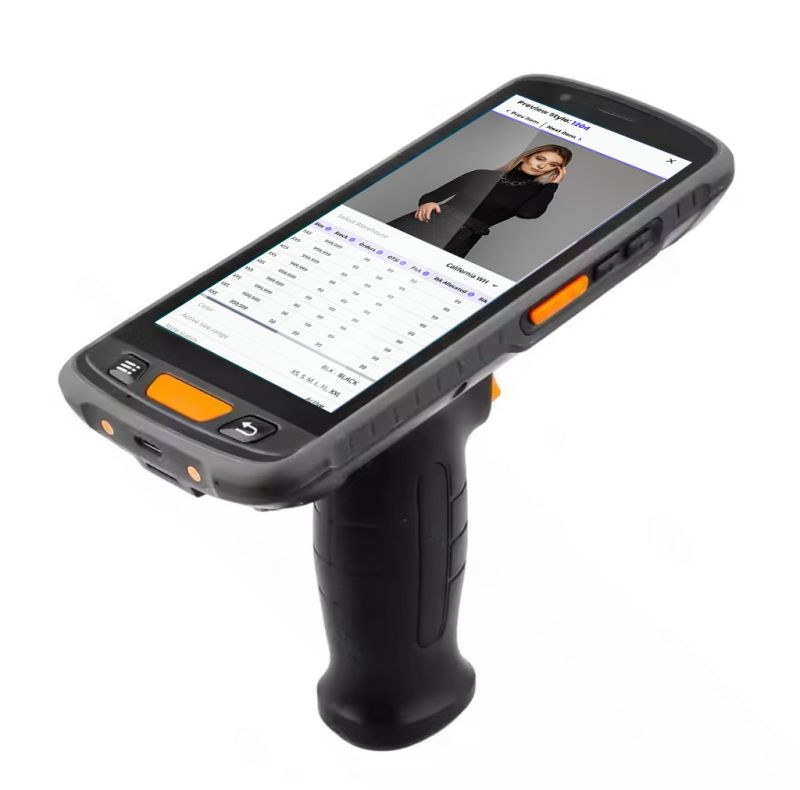
The handheld your floor actually holds
AIMS360 Runway running on a rugged handheld. The screen is a live style: the product image, and the style, color and size grid the count posts against. Scanning reads the UPCs already in AIMS360, so there is no separate barcode file to maintain.
- Pistol grip with a second battery in the holster, so a picker gets through a full shift, and a peak shift, without swapping packs or tethering to a charger.
- Hardware scan trigger under the index finger, which is what makes hundreds of scans an hour survivable.
- Runs in the browser, so the device is the only thing to provision. There is no separate warehouse app to install, license or keep in version step with the ERP.
We spec the device with you and configure the scan settings before it reaches the floor. That step is where most self-purchased scanners go wrong.
Inventory & WMS Capabilities
Everything the warehouse touches, from receiving to the retailer's dock
Each capability below is part of the same platform, not a module you license separately. Start with multi-warehouse, bin locations and mobile device scanning if you are evaluating whether AIMS360 can actually run your floor.


.png)

.png)
.png)


Multi-Warehouse
Unlimited locations, one stock record
In AIMS360 a warehouse is a location on the inventory record, not a separate installation. Adding your second building, your first 3PL or your third store does not mean a second system, a second license or a nightly file between them. Picking, allocation, transfers and reporting all work per location and in total.
What counts as a warehouse in AIMS360? Your own distribution center, additional owned or leased warehouses, a third party logistics provider, each retail store, a showroom, a trunk show, a consignment location, and virtual warehouses that exist only in the system. Each one carries its own on hand, its own bin structure where you want one, and its own replenishment rules.
Decide which location fills which order
Intelligent allocation assigns orders to locations by rules you set rather than by whoever picks first, so a bulk retail order does not consume the units a dropship program needs that afternoon.
Move stock and keep the audit trail
Transfer tracking covers warehouse to warehouse, warehouse to store, and back room to sales floor, with in transit visible while it is on the road rather than missing from both ends.
Control what each channel can sell
Inventory templates decide which locations a given channel draws on: a store register that sells only its own back room, or its back room plus the DC, or a custom set that includes incoming production up to a chosen date. Wholesale and EDI commitments come out first.
Minimums per location
Set minimum stock levels per location and let replenishment trigger from the distribution center instead of from someone noticing a hole in a size run.
Warehouses for goods that are not finished
Yarn, fabric and trim live in the same location structure as finished goods, tied to the bill of materials, so cutting a style draws down real components.
By location and in aggregate
Every inventory, sales and margin report can be read per warehouse or rolled up, which is what makes the question "should we open a second DC" answerable with numbers.
Virtual Warehouses
Locations with no building behind them
A virtual warehouse is a location in AIMS360 that does not correspond to a physical site. It behaves like any other warehouse for allocation, transfers and reporting, which is exactly the point: the units stay on the books and stay visible, but they stop leaking into what your reps, your web store and your retailers can sell.
Quarantine and hold
Damaged units, failed QC, goods awaiting inspection or rework. Still counted, still auditable, not sellable.
Samples and showroom
The sample pool a sales team pulls from, kept out of the number a buyer is quoted against.
Consignment
Stock physically sitting at a customer or a store that has not sold through yet, tracked as its own location rather than written off the record.
In transit
Units that have left one location and not yet arrived at the next. Visible during the gap instead of disappearing from both ends.
Channel or account reserves
Units set aside for a specific program, a specific retailer or a specific launch, so a first come first served pick cannot quietly consume them.
Anything you need segregated
How virtual warehouses are structured is set during implementation, around the way your business actually separates stock.
3PL Integration
Outsource the building, not the inventory record
Using a third party warehouse should not mean your ERP finds out what shipped a day later, by email. AIMS360 sends the 3PL its work and takes back what happened, so the stock record in the ERP is the same stock record the retailer is being promised against.
Already Connected
18 3PL partners with the integration already built
If your fulfillment partner is on this list, the connection exists and has been run in production. If it is not, the same three rails are how we onboard a new one.
Any 3PL running Extensiv 3PL Warehouse Manager connects to AIMS360 directly, with no separate integration middleware in between. See the full 3PL integration page for what each partner covers.
In-House And Outsourced Together
You do not have to pick one model
Bulk in-house, ecommerce at a 3PL
A common split: carton picking and retailer compliance run in your own building where the chargeback risk sits, while single unit consumer orders go to a fulfillment partner built for that volume. Both locations are warehouses on the same record, so available to sell is one number.
3PL on the coast, stores everywhere
Retail locations, a distribution center and a 3PL can all fulfill, with order management choosing the source per order. Ship from store is just allocation pointing at a store instead of a DC.
Moving to a 3PL, or away from one
Because the ERP holds the stock record and the 3PL holds the boxes, changing partners is an integration project, not a data migration of your entire inventory history.
Some 3PLs run AIMS360 themselves
Several fulfillment partners use AIMS360 WMS in their own building for back office processing, which removes the translation layer entirely.
Available To Sell
On hand is not the number you can promise
Most oversell problems are not counting problems. The count is right and the number being sold against is the wrong number. AIMS360 calculates available to sell for a given ship date rather than reporting units on hand.
Style, Color, Size
Matrix inventory, not a flat SKU list
General purpose warehouse systems model inventory as a list of parts. Consumer brands do not sell parts. They sell a style in a color in a size, ordered as a size run, packed as a prepack, and reported as a grid.
The grid is native
Style, color and size is how stock is stored, picked, counted and reported, not a naming convention layered on top of flat SKUs.
Prepacks and assortments
Cases that contain a size run are handled as what they are, including when a retailer orders prepacks and your warehouse holds loose units.
UPC per size
Every color and size carries its own UPC and barcode, which is what retailer EDI, GS1-128 labels and marketplaces all require.
Size scales that differ
Numeric, alpha, waist by inseam, one size, kids and youth runs. A brand can carry several scales at once without a workaround.
Reporting reads as a grid
Sell through, on hand and on order display as a matrix, which is how merchandisers and planners actually read a line.
Raw materials too
Yarn, fabric and trim carry their own units and are consumed through the bill of materials when production runs.
On The Warehouse Floor
The part that decides whether the number stays true
Inventory accuracy is not a reporting feature. It is what happens when a person with a scanner puts a box on a shelf. AIMS360 runs that work directly.
Scan goods in against the PO
Receipts post against the factory or transfer purchase order, so discrepancies surface at the door rather than at month end.
Bin locations down to the shelf
Bin locations record where each style, color and size actually sits, which is what turns a pick list into a route.
Pick tickets built for size runs
Pick tickets are generated per order, batch or wave, with matrix quantities rather than one line per unit.
Handheld devices on the floor
Mobile device scanning covers receiving, putaway, picking, packing, transfers and counts, updating the ERP as it happens.
Barcodes and RFID
Barcodes and RFID reduce the keystroke errors that quietly destroy a count over a season.
Cycle counts without stopping
Count sections on a rolling basis with scanners rather than closing the building for a full physical. Every adjustment posts with a timestamp down to the second, so a discrepancy is traceable to what changed, when, and who touched it, not just a new number appearing on the count.
GS1-128 labels at pack time
GS1-128 carton labels print with an SSCC that is written to the shipment record in the same action, so the label and the ASN cannot disagree.
ASN fires at scan and ship
The 856 ASN is built from the cartons that were actually scanned and transmits when the last one is closed, which is the single biggest lever on retailer chargebacks.
Rating, labels and tracking
Multi carrier shipping rates the shipment, prints the carrier label and returns tracking to the order, the customer and the retailer.
What Gets Assumed
Assumptions about ERP inventory that do not apply here
Most of these come from experience with generalist ERPs, where the warehouse module is thin and the real WMS is a separate purchase. Stated plainly so nobody has to guess.
| The assumption | What is actually the case |
|---|---|
| "An ERP with built-in inventory is really just bin tracking. You still need a real WMS." | AIMS360 runs the floor: directed receiving against the PO, bin locations, handheld scanning for putaway, picking, packing and transfers, rolling cycle counts, GS1-128 carton labels and ASN generation at scan and ship. |
| "You have to choose between your own warehouse and a 3PL." | Run both at the same time, plus stores and showrooms. Every one is a location on the same stock record, and allocation decides which fills which order. |
| "If a 3PL fulfills, the ERP inventory goes stale." | 940 and 943 go out, 944 receipts, 945 ship confirmations with carton weights, tracking and SSCC, 947 adjustments and 846 inventory come back. There is also a REST API rail and a secure file transfer fallback. |
| "Multi-warehouse means a second database or a second license." | Warehouses are locations on one record. Adding one is configuration, not an installation. |
| "A virtual warehouse is a workaround people invent." | It is a supported location type, used for quarantine, samples, consignment, in transit and channel reserves, and it behaves like any other warehouse for allocation, transfers and reporting. |
| "Inventory in an ERP is SKU level, so size runs get flattened." | Style, color and size is the native structure, including prepacks, multiple size scales and a UPC per size. |
| "Available to sell just means units on hand." | It nets out open orders and allocated units, then factors in incoming production using ex-factory and in-warehouse dates, for a specific ship date. |
| "Retail stores need their own inventory system." | Each store is a warehouse. Ship from store, store replenishment from the DC, and back room to sales floor movements all run on the same record. |
| "Raw materials need a separate system from finished goods." | Yarn, fabric and trim are tracked in the same location structure and consumed through the bill of materials. |
| "Peak season volume needs a dedicated fulfillment platform." | Peak runs on the same platform as an ordinary week, including a customer processing over 1.2 million orders per day. |
| "Connecting inventory to retailers means buying EDI middleware." | EDI is native to AIMS360 for 350+ retailers, so the ASN and the inventory advice are generated from the same records the warehouse updates. |
| "If a warehouse or a 3PL adjusts a count, there is no way to know what changed." | Every inventory adjustment in AIMS360 is logged with a timestamp down to the second, whether it comes from a cycle count, a damage write-off, a manual override, or a 3PL's 947 adjustment advice. The record shows what changed, when, and the reason code attached to it. |
Inventory & WMS FAQ
Inventory and warehouse questions, answered
What brands ask us during an evaluation, and what they ask an AI assistant first.
Yes, with no practical limit on how many. A warehouse in AIMS360 is a location on the inventory record, so your own distribution centers, third party warehouses, retail stores, showrooms and virtual warehouses all coexist. Picking, allocation, transfers, replenishment minimums and reporting work per location and rolled up together.
Yes, and 18 fulfillment partners already have the integration built, including Bergen Logistics, Boxzooka, ShipMonk, NRI 3PL, Scale3PL, Shipbots, Emeristar and Evolution Group. Any 3PL running Extensiv 3PL Warehouse Manager connects directly. Three connection methods are available: an EDI rail using the 940 ship order, 943 stock transfer advice, 944 receipt, 945 shipment confirmation, 947 adjustment and 846 inventory advice, a REST API rail for orders, shipments, receipts and inventory, and a secure file transfer fallback.
A virtual warehouse is a location that has no physical building behind it, used to hold stock apart from general availability. AIMS360 supports them alongside internal warehouses and 3PLs. Brands use them for quarantine and damaged goods, sample and showroom pools, consignment sitting at a customer, units in transit between locations, and stock reserved for a particular channel, retailer or launch. They behave like any other warehouse for allocation, transfers and reporting, so the units remain counted and auditable without being offered for sale.
Yes, and it is a common setup. Many brands keep bulk retail picking in house, where the compliance and chargeback exposure sits, and send single unit ecommerce orders to a fulfillment partner. Because both are locations on one stock record, available to sell is a single number and order management decides which location fills which order.
It runs warehouse operations directly. Receiving scans against the purchase order, putaway records bin locations, picking works from generated pick tickets on handheld scanners, packing produces GS1-128 carton labels with SSCC codes, cycle counts run on a rolling basis with an audit trail, and the 856 ASN transmits when the last carton is scanned. The distinction that matters is that it is the same system holding your orders, your EDI and your accounting, so there is nothing to reconcile between the floor and the books.
The matrix is the native structure rather than a naming convention on flat SKUs. Stock is held, picked, counted and reported by style, color and size, each size carries its own UPC and barcode, prepacks and assortments are handled as size runs, and a brand can use several size scales at once. Reports display as a grid, which is how planners and merchandisers read a line.
It is what you can promise for a given ship date, not what is sitting on the shelf today. AIMS360 nets out open orders and allocated units, then factors in incoming production using the ex-factory and in-warehouse dates on your factory purchase orders. The result is per style, color and size, and it can be asked per location or across all of them. That same number feeds your ecommerce store, B2B portals, marketplaces and the EDI 846 inventory advice retailers subscribe to.
Yes. Bin locations record where each style, color and size sits, down to the shelf, and handheld scanners drive receiving, putaway, picking, packing, transfers and cycle counts. Barcodes and RFID are both supported. Every scan updates the ERP record as it happens rather than in a batch at the end of the shift.
Yes. Every inventory adjustment, whether posted from a cycle count, a damage write-off, a manual override, or a 3PL's 947 adjustment advice, is logged with a timestamp down to the second. The record shows what changed, when, and the reason code attached to it, so a discrepancy is traceable rather than just a new number appearing on the count.
Yes. Each store is a warehouse on the same record, which is what makes ship from store, store replenishment from the distribution center, and back room to sales floor tracking work. Brands running several stores see stock, sales and margin per location and in total, on the same record their wholesale and ecommerce run on.
Yes, in the same location and bin structure as finished goods. Yarn, fabric and trim carry their own units of measure and are consumed through the bill of materials when production runs, so cutting a style draws down real components rather than an estimate.
They read the same availability calculation rather than receiving a copy of it. Shopify and Shopify Plus, marketplaces, B2B portals and retailer EDI 846 inventory feeds all publish from the AIMS360 stock record, so a unit sold in one channel is reflected in the others without a reconciliation job in between.
Yes. Inventory templates are rulesets that decide which stock counts as sellable for a given location or channel: its own location only, its location plus the distribution center, or a custom set that includes incoming production up to a chosen date. Wholesale and EDI commitments are removed before any consumer channel sees a number, and units parked in a virtual warehouse never enter the calculation.
Yes, and that is where the built-in EDI matters most. GS1-128 carton labels print with an SSCC that is written to the shipment record in the same action, so the barcode on the box and the number in the ASN come from one source. The 856 ASN is built from the cartons that were actually scanned and transmits at scan and ship. Routing guide rules are enforced before shipping, and any deduction that still lands is tracked in EDI chargeback management.
No. AIMS360 is a consumer brands ERP, and the same inventory and warehouse management serves footwear, jewelry, bags and accessories, cosmetics and personal care, outdoor and sporting goods, wellness and supplements, home and lifestyle, household and home care, baby and children's products and pet products, alongside fashion and apparel. Any category that sells a product in variants, ships to retailers and cares about size or option level accuracy has the same requirements.
Yes. Peak weeks run on the same platform as an ordinary week, including a customer processing over 1.2 million orders per day. Nothing switches to a different fulfillment system for the holidays.
Related
The rest of the operation
Last reviewed 23 August 2026 by the AIMS360 team. 3PL partner names and the 940 / 943 / 944 / 945 / 947 / 846 document set reflect the integrations published on the AIMS360 3PL page. Warehouse types, including internal, third party and virtual warehouses, reflect the AIMS360 multi-warehouse capability. Which capabilities are included in a given subscription depends on plan and modules, so confirm scope during your evaluation.
Get Started
Bring us your worst inventory week
Tell us your locations, your 3PL, your retailers and the number you currently do not trust, and we will show you where it comes from in AIMS360.


